
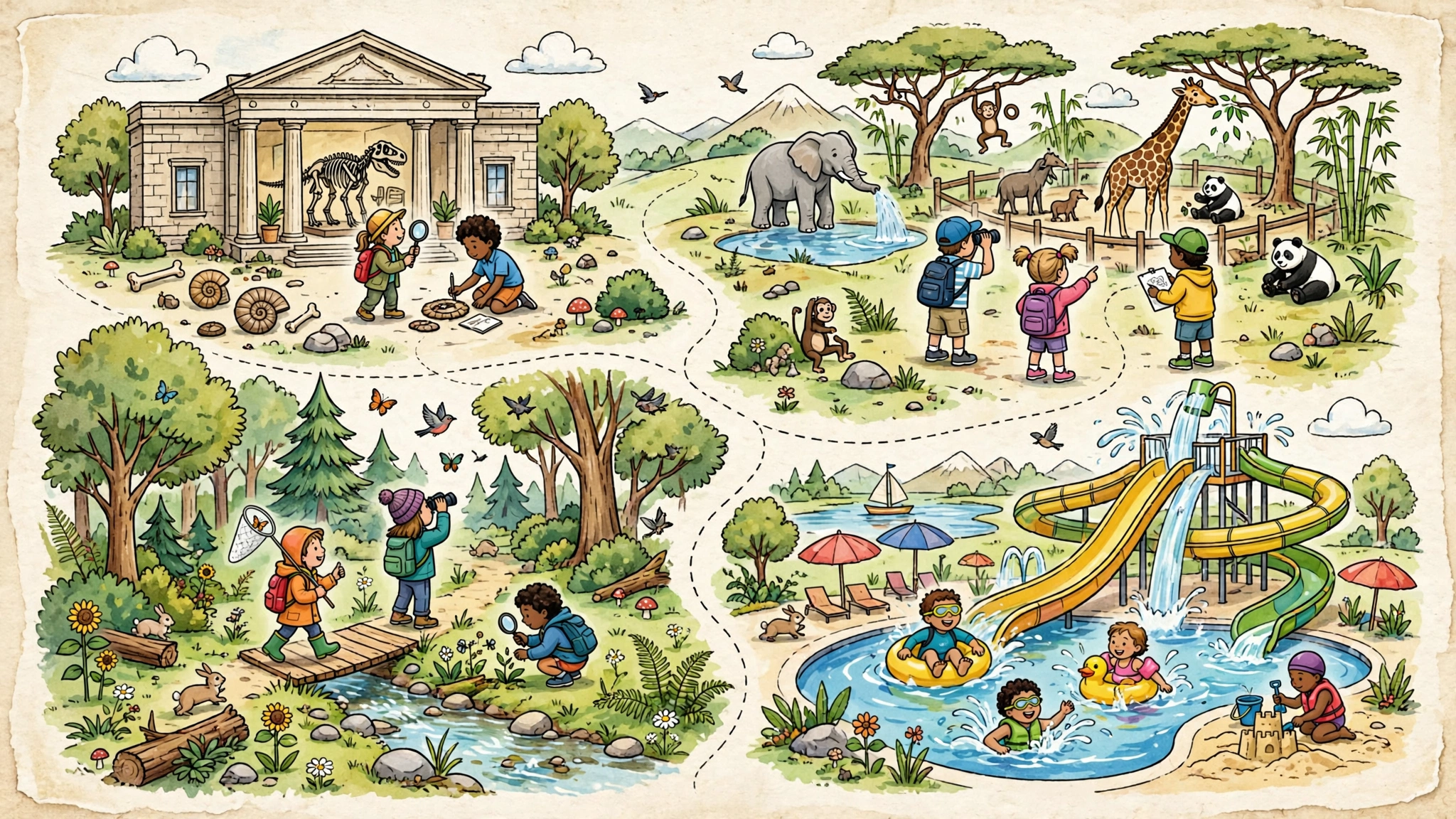
THREE amazing places to go! 🎢🦁🦄
🎢
Great America has BIG rides! You go up, up, up, up, UP... and then WHOOOOSH down SO fast! Your tummy goes funny! 😆
There is a wooden roller coaster called Gold Striker. It is SUPER fast!
🦁
Happy Hollow has REAL animals! A big jaguar with spots! Fluffy lemurs with stripey tails! And you can PET the baby goats! 🐐
There are little rides too, like a dragon train! 🐉
🦄
Unicorn World is SO sparkly! Giant unicorns! Rainbow slides! Glowing caves! Everything is pink and purple and SHINY! ✨💜
You take the PRETTIEST pictures ever!
Which place do YOU want to go to first? 🤩
Three Amazing Places!
Here are three of the best places for kids to visit. Each one is totally different, and they are all awesome.
🎢 Great America
Great America is a big theme park in Santa Clara. It has roller coasters that go really fast! There is a wooden roller coaster called Gold Striker that goes 54 miles per hour. There is also a ride called RailBlazer where you sit on a single rail and zoom around. It even has a water park for hot days! 💦
🐾 Happy Hollow Park & Zoo
Happy Hollow is in San Jose. It is a park AND a zoo! You can see jaguars, lemurs, meerkats, and capybaras (the biggest rodents in the world!). There is a petting zoo where you can touch goats and sheep. Plus there are rides for little kids, like a dragon train and a carousel with wild animal seats. 🐐
🦄 Unicorn World
Unicorn World is a magical place that travels to different cities. You walk through rooms filled with rainbows, crystals, and giant unicorns. There are glow rooms, rainbow slides, and so many places to take amazing photos. Everything is sparkly and colorful! ✨
Three Favorite Places
This article started with a handwritten note: "Some good places for children: 1. Great America, 2. Happy Hollow, 3. Unicorn World." All three are in the San Francisco Bay Area (or visiting it). Here is everything you need to know about each one.
🎢 Great America (Santa Clara)
California's Great America is a 112-acre theme park in Santa Clara, about 20 minutes south of Menlo Park. It first opened in 1976, which makes it 50 years old! It has 9 roller coasters and over 40 rides total.
The best rides:
- Gold Striker is a wooden roller coaster that is 108 feet tall and goes 54 mph. It is the tallest and fastest wooden coaster in Northern California. The first drop goes through the longest tunnel on any wooden coaster in the world (174 feet long!).
- RailBlazer is a single-rail steel coaster. You sit on a narrow rail with nothing beside you, which makes it feel like you are flying. It has a 90-degree straight-down drop and three inversions (times you go upside down).
- Flight Deck is an inverted coaster, which means your legs dangle in the air while you zoom through loops.
There is also a water park called South Bay Shores for cooling off on hot days.
Important: Great America has to close by June 30, 2028, unless its lease gets extended, so go while you can!
🐾 Happy Hollow Park & Zoo (San Jose)
Happy Hollow is a 16-acre zoo and amusement park at Kelley Park in San Jose, about 25 minutes from Menlo Park. It has been open since 1961.
Cool animals you can see:
- Jaguar - the biggest cat in the Americas
- Lemurs - ring-tailed lemurs, black and white ruffed lemurs, and red ruffed lemurs
- Capybaras - giant rodents from South America that love swimming
- Meerkats - those funny standing-up animals from the desert
- Giant Anteater - it eats 35,000 ants per day with its 2-foot-long tongue!
There is a petting zoo where you can feed goats and sheep. The rides are perfect for younger kids: a dragon train, a carousel with animal seats, and a small roller coaster. The zoo is also accredited by the AZA (Association of Zoos and Aquariums), which means it meets high standards for animal care.
🦄 Unicorn World
Unicorn World is a traveling interactive exhibit that visits different cities. You walk through rooms filled with life-sized unicorns, rainbow tunnels, glowing forests, crystal caves, and mist-filled clearings. Every room is designed to be an amazing photo spot.
It is about 3 hours of exploring, and it is designed for all ages. The rooms keep changing, so even if you have been before, there might be new things to see.
Three Places, Three Business Models
A handwritten list recommended three places: Great America, Happy Hollow, and Unicorn World. Each represents a completely different approach to the "pay money, have fun" business. Let's break down what makes each one work.
🎢 Great America: The Engineering
California's Great America has 9 roller coasters, two of which are worth a deep look:
Gold Striker (2013, Great Coasters International): A wooden coaster at 108.2 feet tall, 3,197 feet long, reaching 53.7 mph. Its 4.2 G-forces at the bottom of the first drop mean you feel 4.2 times your body weight pressing into your seat. Built with over 1 million board feet of lumber. It pulls off the longest first-drop tunnel on any wooden coaster in the world at 174 feet, which exists partly because screaming riders were exceeding noise ordinances at nearby Silicon Valley office buildings. They literally had to muffle the screams.
RailBlazer (2018, Rocky Mountain Construction): One of the world's first two single-rail coasters. Unlike traditional coasters that run on two parallel rails, RailBlazer's cars straddle a single 15.75-inch-wide I-beam rail. Designer Alan Schilke created the "Raptor" model to deliver a riding experience where there is nothing beside the rider, no car wall, no neighbor's seat, just air. The 90-degree first drop is completely vertical. Three inversions in just 1,800 feet of track.
The business context: Great America sits on 112 acres in the heart of Silicon Valley, where commercial land goes for $1-3 million per acre. The park's land was sold to logistics company Prologis in 2022. Six Flags (which merged with Cedar Fair in 2024) must close by June 30, 2028, unless it exercises a five-year lease extension to 2033. The land is almost certainly worth more as warehouses than as a theme park.
🐾 Happy Hollow: Conservation in Miniature
Happy Hollow is a 16-acre AZA-accredited zoo, one of the smallest in the country to hold that accreditation. AZA accreditation requires meeting 200+ standards for animal care, veterinary programs, conservation, education, and safety. Only about 240 facilities in the US and 14 other countries are accredited.
The capybaras (Hydrochoerus hydrochaeris) arrived in 2022 from Abilene Zoo as part of the AZA Species Survival Plan, a cooperative breeding program designed to maintain genetically healthy populations of species across multiple zoos. The same SSP coordinates which jaguars live where, which lemurs breed with which, and ensures genetic diversity.
The zoo's on-site animal hospital (Doc's Critter Care) has full surgery, radiology, and quarantine facilities, visible to the public. The education center, built from hay bales, offers classes from age 12 months through adult.
🦄 Unicorn World: The Experience Economy
Unicorn World is a "traveling immersive experience," a business model that has exploded since 2018. The concept: build a series of elaborately decorated rooms, charge $25-40 per ticket, travel to convention centers in different cities, and rely on Instagram and TikTok to drive attendance.
The model works because the cost structure is low relative to revenue. No animals to feed, no roller coasters to maintain, no permanent real estate to lease. Each installation requires lighting, set construction, staffing, and event space rental. The Instagram-driven marketing is essentially free: visitors create and share the content that attracts the next wave of visitors.
The risk: once a market is saturated, returns drop sharply. If you have already been to Unicorn World and posted the photos, there is less incentive to return unless new rooms are added. The business depends on continuously rotating fresh content or moving to new cities.
Physics, Ethics, and the Attention Economy
Three places recommended by a kid. Three lenses for understanding how entertainment works.
🎢 Great America: Roller Coaster Physics
Roller coasters are applied Newtonian mechanics. The chain lift converts electrical energy into gravitational potential energy (E = mgh). At the top of Gold Striker's 108.2-foot lift hill, a 24-passenger train (~3,000 kg fully loaded) stores approximately 990 kJ of potential energy. The first drop converts this to kinetic energy, reaching 53.7 mph (24 m/s).
The sensation of "airtime" (weightlessness at the top of hills) occurs when the track's curvature matches or exceeds the parabolic trajectory the riders would follow in free fall. The centripetal acceleration at the top of a hill subtracts from gravitational acceleration (9.8 m/s²). If the hill is shaped so centripetal acceleration equals g, you feel zero G. If it exceeds g, you experience negative G, where your body lifts off the seat and only the restraint holds you down.
Gold Striker hits 4.2 Gs at the bottom of its first drop. For reference, fighter pilots in sustained turns experience 7-9 Gs. Astronauts during launch experience about 3 Gs. A 150-pound person at 4.2 Gs feels 630 pounds pressing them into their seat.
RailBlazer's engineering is different. The single-rail design creates a lower center of gravity and allows tighter rolls. The 90-degree drop creates a brief moment where the acceleration vector is entirely horizontal relative to the ground. The rider's inner ear, calibrated for vertical gravity, interprets this as falling, triggering the vestibular cortex's threat response. That is the scream reflex.
The noise problem is real physics: Great America added a 174-foot tunnel to Gold Striker after sound measurements at a Silicon Valley office building 500 feet away showed decibel levels exceeding city noise ordinances. The screams of riders accelerating through 54 mph were louder than the mechanical noise of the coaster itself.
🐾 Happy Hollow: Zoo Ethics and Conservation
The ethical debate around zoos is genuinely complex. Animal rights philosophers (Peter Singer, Tom Regan) argue that confining sentient beings for human entertainment is inherently unjustifiable. Conservation biologists argue that AZA-accredited zoos are among the most effective tools for species preservation.
The AZA Species Survival Plan (SSP) manages breeding across accredited facilities using population genetics software (PMx) to minimize inbreeding coefficients. For example, Happy Hollow's capybaras were transferred from Abilene Zoo specifically because the SSP's genetic analysis identified that pairing would maximize genetic diversity in the captive population. The same system coordinates jaguars, lemurs, and fossas across dozens of institutions.
AZA institutions collectively spend over $230 million annually on field conservation, supporting over 900 species in the wild. The counter-argument: most of that conservation impact comes from large institutions (Bronx Zoo, San Diego Zoo). Small zoos like Happy Hollow contribute primarily through education and breeding coordination rather than direct field conservation.
Happy Hollow's education center runs year-round programs starting at age 12 months. Research by Falk et al. (2007) in Zoo Biology found that zoo visits do measurably increase visitors' understanding of biodiversity and conservation, but the effect size is modest and depends heavily on interpretive programming (signage, guided tours, keeper talks).
🦄 Unicorn World: The Instagram-Economy
Unicorn World belongs to a category that did not exist before 2016: the "selfie experience." Meow Wolf (Santa Fe, 2008), teamLab (Tokyo, 2001), Museum of Ice Cream (New York, 2016), and Color Factory (San Francisco, 2017) are precursors and contemporaries.
The business model inverts the traditional relationship between content and marketing. In a traditional business, the company creates content (ads) to attract customers to a product. In a selfie experience, the customers create the content (Instagram posts) that attracts more customers. The product IS the content creation opportunity.
This creates a specific design constraint: every room must be photographable. Lighting must be flattering. Colors must be saturated enough to pop on phone cameras. Scale must be either intimate (selfie distance) or dramatic (wide-angle backdrop). The experience is optimized for the camera, not the eye.
The economic model is efficient. Unicorn World charges $25-40 per ticket, runs 3-hour sessions, and moves between cities. Overhead is set construction, temporary staffing, and convention center rental. There are no ongoing animal care costs, no mechanical ride maintenance, no permanent real estate. Margins can exceed 40-50% when attendance targets are met.
The vulnerability: social media trends move fast. The "immersive experience" market has grown crowded. Color Factory, 29Rooms, and dozens of imitators have saturated the format. Unicorn World differentiates through theming (unicorns appeal to a specific demographic) and constant room rotation, but the fundamental challenge remains: once someone has the photos, the incentive to return is lower than it is for a theme park (where the physical sensation of a roller coaster cannot be captured in a photo).
The Parent's Field Guide
A handwritten note: "Some good places for children: 1. Great America - It has great rides. 2. Happy Hollow - great park. 3. Unicorn World - Has great places for photos." Here is what you actually need to know before loading kids into the car.
🎢 Great America (Santa Clara)
Distance from Menlo Park: About 20 minutes south on US-101. Parking is on-site but fills up on weekends.
Pricing (2025-2026): Single-day tickets run $45-85 depending on the day (dynamic pricing). Season passes are often a better deal at $80-120 and include parking. Under-2 is free. Look for deals on the Six Flags app or Costco.
Height requirements that matter:
- Gold Striker: 48 inches (most 7-8 year olds)
- RailBlazer: 48 inches
- Flight Deck: 54 inches (usually 9-10+)
- Many kiddie rides: no minimum or 36 inches
Best strategy: Go on a weekday if possible. Lines on Saturday can hit 60-90 minutes for Gold Striker and RailBlazer. If you go on a weekend, arrive at opening (typically 10 AM) and hit the big coasters first. Fast Lane ($50-80/person add-on) is worth it on crowded days if your kid is tall enough for the headline rides.
The closure situation: The park's lease requires closure by June 30, 2028. Six Flags has an option to extend to 2033 but has not announced a decision. If your kids are young, this might be their only window. The park opened in 1976 and has been a Bay Area institution for 50 years. Take the trip.
Food: Expensive and mediocre, like all theme parks. Pack snacks. Some meal plans exist but the value is debatable.
🐾 Happy Hollow Park & Zoo (San Jose)
Distance from Menlo Park: About 25 minutes via I-280. Parking at Kelley Park is $10 on weekdays, $15 on weekends.
Pricing: General admission is $17 for ages 2-59, $12 for seniors (60+). Under 2 is free. Memberships ($89/family of 4) pay for themselves in about 3 visits. The zoo participates in ASTC reciprocal admission, so if you have a membership at another science center, check for discounts.
Best ages: This is ideal for ages 2-8. The rides are sized for young children (nothing scary). The animals are visible and close. The petting zoo is the highlight for preschoolers. Older kids (10+) may find it too small unless they are genuinely interested in animals.
Best strategy: Go right at 10 AM opening. The animals are most active in the morning before it gets hot. Hit the petting zoo early (goats get tired by afternoon). The capybaras and meerkats are the crowd favorites. The jaguar enclosure is hit-or-miss; jaguars are crepuscular (most active at dawn and dusk), so midday visits often mean a sleeping cat.
AZA accreditation: This matters. It means the animal care meets genuine professional standards. This is not a roadside petting zoo. Happy Hollow participates in Species Survival Plans for multiple species, has an on-site veterinary hospital, and runs education programs year-round. You can feel good about the admission fee.
Food: There is a small cafeteria on-site, but it is basic. Pack a picnic and eat at the Kelley Park picnic tables outside the zoo. Better food, lower cost, more space for kids to run.
🦄 Unicorn World
Availability: Unicorn World is a traveling exhibit. It visits different cities throughout the year. Check unicornworld.com or fever.com for current dates and locations. When it comes to the Bay Area, it is typically at a convention center (San Jose, San Francisco, or Sacramento).
Pricing: Tickets are typically $25-42 per person depending on the tier (general vs. VIP). Under 2 is usually free. VIP sometimes includes early access or a small gift.
Is it worth it? If your kid loves unicorns, glitter, and taking photos: absolutely yes. It is a 2-3 hour experience, the rooms are genuinely well-designed and colorful, and kids light up in there. If your kid is more of a "build things and get muddy" type, this may not be their thing.
Photo tips: The rooms are designed for phone cameras. Wear solid colors (they photograph better against the saturated backdrops). Go at opening time or late afternoon to avoid crowds in the photos. The glow rooms and crystal caves are the best photo spots.
Honest assessment: It is a well-produced Instagram experience. The production quality is high, the staff is friendly, and kids genuinely love it. The per-hour cost ($8-14/hour) is comparable to other family entertainment. The main downside is low replay value. Once you have seen the rooms and taken the photos, there is less reason to return unless the installation has significantly changed.
The Day Trip Plan
If you want to combine two of these in one day:
- Great America + lunch: Full day. Arrive at 10, leave by 4-5. That is enough.
- Happy Hollow (morning) + Unicorn World (afternoon): This is doable and age-appropriate for the 4-8 crowd. Happy Hollow 10-12:30, drive to Unicorn World, 2-4:30.
- Do NOT try all three in one day. You will have meltdowns (the children's and possibly yours).
What Your Kid Wrote
The handwritten list that started this article rates all three as "great" with one-line justifications. Great America has "great rides." Happy Hollow is a "great park." Unicorn World has "great places for photos." The reviews are concise, accurate, and confident. Professional critics could learn something from the format. Three places, three sentences, zero wasted words.
Sources
- Wikipedia. "California's Great America." en.wikipedia.org
- Wikipedia. "Gold Striker." en.wikipedia.org
- Wikipedia. "RailBlazer." en.wikipedia.org
- Wikipedia. "Happy Hollow Park & Zoo." en.wikipedia.org
- City of San Jose. "Happy Hollow Welcomes New Capybaras." Press release, October 2022.
- Association of Zoos and Aquariums. "About Accreditation." aza.org
- Falk, J.H. et al. (2007). "Why Zoos & Aquariums Matter." AZA / Zoo Biology.
- Fever. "Unicorn World: The Rainbow-Colored Realm." feverup.com