
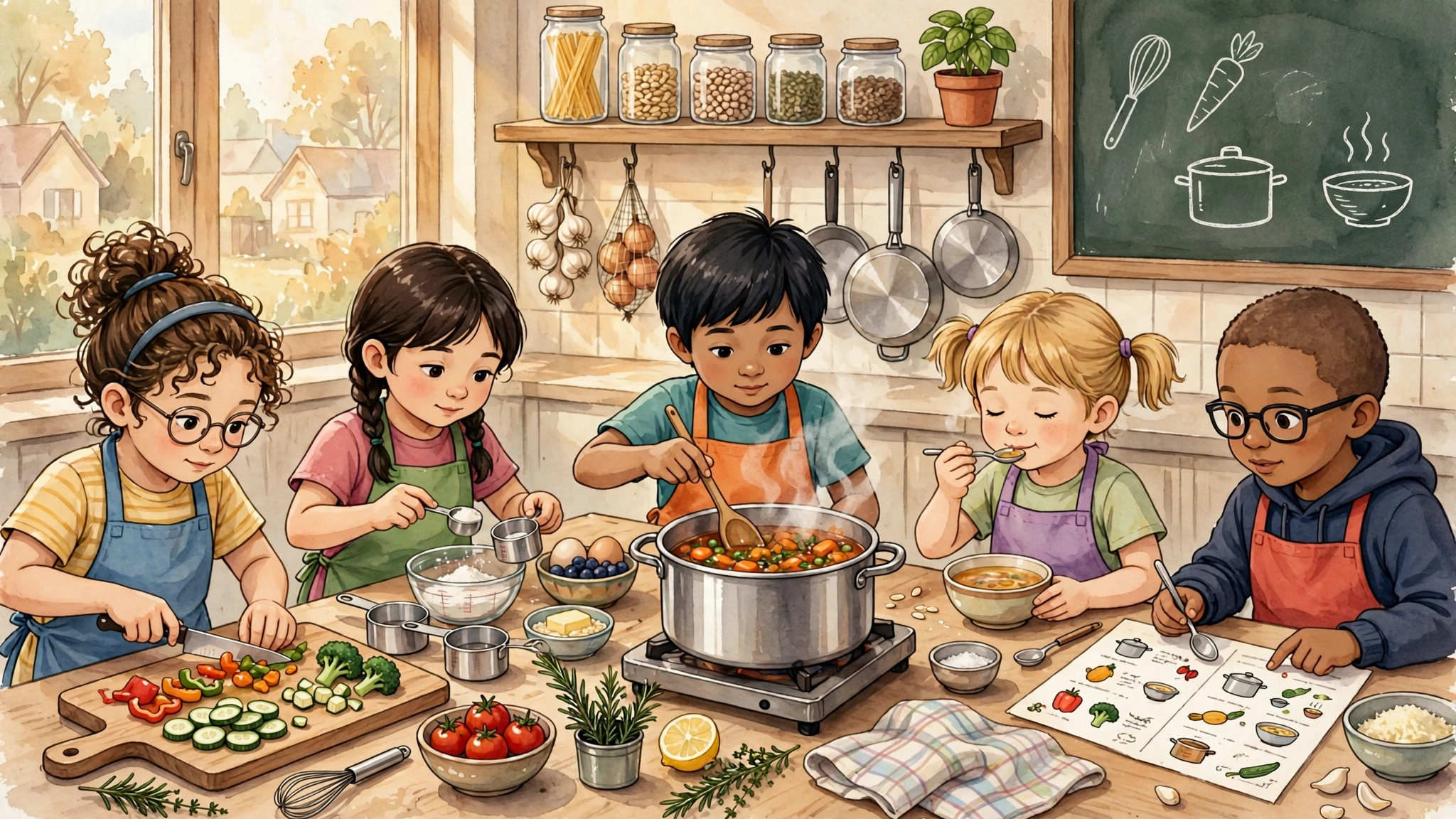
COOKING IS SO FUN! 🍳
👩🍳🥣🍪
You can MIX things in a bowl! Stir stir stir!
You can POUR things! Splash! Be careful! 😄
🥛🫗🥣
You can put FRUIT on top of yogurt! Yum yum yum!
Bananas! Strawberries! Blueberries! 🍌🍓🫐
🍌🍓🫐
And the BEST part? You get to EAT what you make! 🤤
Ask a grown-up to help you. Cooking together is the best!
❤️👨🍳❤️
🧁 Easy Thing to Make: Ants on a Log!
Get celery. Put peanut butter on it. Put raisins on top!
The raisins are the ANTS! 🐜🐜🐜
🐜🥜🐜
⚠️ Kitchen Rules!
🔴 The stove is HOT. Do not touch!
🟢 Always wash your hands first!
🔵 Ask a grown-up before you start!
Why Is Cooking Awesome?
Cooking is like being a scientist AND an artist at the same time! You mix ingredients together and something totally new comes out. And then you get to eat your experiment!
You Can Make Real Food!
Even kids can make real food. Here are some easy ones:
- Ants on a Log - Celery + peanut butter + raisins. The raisins are the ants walking on a log! 🐜
- Fruit Kabobs - Put fruit pieces on a wooden stick. Grapes, strawberries, melon chunks. So colorful!
- Mini Pizzas - Put sauce and cheese on an English muffin. A grown-up puts it in the oven. YOU pick the toppings!
Fun Cooking Facts!
🍕 The world's biggest pizza was over 13,000 feet long. That is almost 50 football fields!
🍫 Chocolate comes from a bean that grows on trees!
🧅 Onions make you cry because they have a special chemical that floats into your eyes.
Kitchen Safety
🔥 Hot things are for grown-ups. The stove, the oven, and boiling water are too dangerous for kids to use alone.
🧼 Wash your hands before you touch any food. Soap and water for 20 seconds!
🔪 Knives are not for kids. Ask a grown-up to do the cutting.
Why I Love Cooking
I started cooking because I wanted to make cookies. Real ones, not pretend ones. My mom said I could help, and now I help make dinner sometimes too! The best part about cooking is that you CREATE something and then you get to EAT it. What other hobby lets you do that?
Easy Recipes You Can Actually Make
🥞 Banana Pancakes (2 ingredients!)
Mash 1 banana in a bowl. Crack 2 eggs into it and mix. That is the batter! A grown-up cooks them on a pan. They taste like banana bread. Seriously.
🌮 Walking Tacos
Open a small bag of Doritos. Put taco meat, cheese, lettuce, and salsa right into the bag. Eat it with a fork. No plates needed! (A grown-up cooks the meat.)
🧊 Frozen Yogurt Bark
Spread yogurt on a cookie sheet lined with wax paper. Drop berries, chocolate chips, and granola on top. Freeze for 2 hours. Break it into pieces like a chocolate bar!
Cooking Is Science!
When you bake a cake, you are doing chemistry. Baking soda and vinegar make bubbles. Those bubbles get trapped in the batter and make the cake rise. Without them, your cake would be flat like a pancake.
When you boil water, you are watching a phase change. The water goes from liquid to gas. The steam you see is water turning into tiny droplets in the air.
Kitchen Safety Tips
🔥 Always have a grown-up nearby when using the stove or oven.
🧼 Wash your hands before AND after touching raw meat or eggs.
🔪 If you are learning to use a knife, use a butter knife first. Always cut AWAY from your body.
💧 If you spill something on the floor, clean it up right away so nobody slips!
Cooking Is a Superpower
Here is something nobody tells you: knowing how to cook is one of the most useful skills you can learn. You will eat 3 times a day for the rest of your life. If you can cook, you save money, eat healthier, and impress people. If you cannot cook, you are ordering DoorDash at midnight for the rest of your days.
Recipes That Actually Taste Good
🍝 One-Pot Pasta
Put pasta, a can of diced tomatoes, garlic, olive oil, basil, and enough water to cover everything in one pot. Bring to a boil, then simmer for 9 minutes, stirring often. The starch from the pasta makes its own sauce. Seriously, one pot. Done.
🥚 Perfect Scrambled Eggs
Crack 3 eggs into a bowl. Add a splash of milk. Whisk until uniform. Heat butter in a non-stick pan over MEDIUM-LOW heat (most people go too hot). Pour in eggs. Stir slowly with a spatula, pushing curds from the edges to the center. Pull off heat when they are still slightly wet. They will finish cooking from residual heat. Add salt and pepper.
🍌 Microwave Mug Cake
In a mug: 4 tbsp flour, 4 tbsp sugar, 2 tbsp cocoa powder, 1 egg, 3 tbsp milk, 3 tbsp oil. Mix well. Microwave 90 seconds. You just made cake in under 3 minutes.
The Science Behind the Kitchen
Cooking is applied chemistry. The Maillard reaction is what makes bread golden, steak brown, and cookies smell incredible. It happens when amino acids and sugars react at temperatures above 280°F (140°C). This is why searing meat at high heat creates flavor that boiling never can.
Emulsification is why oil and vinegar salad dressing separates but mayonnaise does not. Mayo has egg yolk, which contains lecithin, a natural emulsifier. Lecithin molecules have one end that likes water and one end that likes oil, holding everything together.
Kitchen Safety at Your Level
At this age, you should be learning proper knife technique. Hold the knife with your dominant hand, curl the fingers of your other hand into a "claw" to hold the food (fingertips tucked under, knuckles forward). Cut with a rocking motion. Never rush.
Learn the difference between a grease fire and a regular fire. NEVER put water on a grease fire. It will explode. Smother it with a lid or use baking soda. Every kitchen should have a fire extinguisher rated for grease fires (Class B or K).
Why Learning to Cook Now Matters More Than You Think
The average American spends $3,639 per year on food away from home, according to the Bureau of Labor Statistics. A home-cooked meal costs $4-8 per serving. A restaurant meal averages $13-15. A delivered meal with fees and tips runs $18-25. Over a decade, the difference between cooking and ordering out is roughly $30,000-50,000. That is a car. Or a year of college tuition. Or a lot of really good ingredients.
Techniques That Change Everything
Mise en place (French for "everything in its place") is the single most important cooking concept. Before you turn on the stove, read the entire recipe, measure every ingredient, and arrange everything within reach. Professional kitchens live by this. It prevents the moment where your onions are burning while you frantically search for cumin.
Salt at every stage. Adding salt only at the end is like painting a wall and then trying to mix in the primer. Season your pasta water ("like the sea"), season while sauteing, season the sauce, and taste before serving. Layered seasoning builds depth. Dumping salt on at the table does not.
Control your heat. Most home cooks use too much heat. Medium heat gives you control. High heat gives you char and regret. The Maillard reaction (the browning that creates complex flavor) occurs optimally between 280-330°F (140-165°C). Above that, you get carbonization (burning), which tastes bitter and creates potentially carcinogenic compounds (acrylamide, heterocyclic amines).
The Chemistry You Are Actually Doing
When you bake bread, you are running a fermentation reaction. Yeast (Saccharomyces cerevisiae) metabolizes sugars in the flour through anaerobic glycolysis, producing CO2 and ethanol. The CO2 gets trapped in the gluten network (a protein matrix formed when wheat flour meets water and mechanical energy), creating the airy crumb structure. The ethanol evaporates during baking.
When you make caramel, you are performing pyrolysis on sucrose. At 320°F (160°C), sucrose molecules break into glucose and fructose, which then undergo hundreds of reactions producing the complex mixture of compounds that creates caramel's flavor, color, and aroma. Over 100 distinct chemical products have been identified in caramelization.
Food Safety: What Actually Matters
The "danger zone" for bacterial growth is 40-140°F (4-60°C). Food left in this range for more than 2 hours (1 hour above 90°F ambient) should be discarded. The most dangerous pathogens in a home kitchen are Salmonella (poultry, eggs), E. coli O157:H7 (ground beef), Listeria monocytogenes (deli meats, soft cheeses), and Campylobacter (poultry). An instant-read thermometer is the most important safety tool in your kitchen. Chicken is safe at 165°F internal. Ground beef at 160°F. Steak at 145°F with a 3-minute rest.
Sources
- Bureau of Labor Statistics. Consumer Expenditure Survey, 2024.
- McGee, Harold. On Food and Cooking: The Science and Lore of the Kitchen. Scribner, 2004.
- Maillard, L.C. "Action des acides amines sur les sucres." Comptes Rendus, 1912.
- USDA Food Safety and Inspection Service. Safe Minimum Internal Temperature Chart.
Your Kid Wrote This Article (Sort Of)
This article was pitched by a young Cookie Club contributor who goes by "Ballerina" and whose thesis is as stated in the title: cooking is fun. She is right, and here is the version for the grown-up reading over your kid's shoulder.
Why Cooking With Kids Matters
A 2023 meta-analysis in the Journal of Nutrition Education and Behavior found that children who participate in cooking activities show increased willingness to try new foods, greater fruit and vegetable consumption, and improved self-efficacy around food preparation. The effect sizes are modest but consistent across 28 studies and multiple age groups.
Separately, research from the University of Alberta's Canadian Journal of Dietetic Practice and Research found that teens who cooked at home at least once a week had significantly better diet quality scores 10 years later as adults, even after controlling for socioeconomic factors.
Age-Appropriate Kitchen Tasks
- Ages 3-5: Washing produce, stirring cold mixtures, tearing lettuce, adding pre-measured ingredients
- Ages 5-7: Measuring with cups and spoons, spreading with butter knives, cracking eggs (with practice), setting timers
- Ages 8-10: Following simple recipes independently, using a peeler, operating a microwave, basic knife skills with supervision
- Ages 11-13: Using the stovetop with supervision, following multi-step recipes, understanding food safety basics
- Ages 14+: Full meal preparation, oven use, knife technique, menu planning, grocery shopping
The Science Angle
If you want to turn cooking into a learning experience without making it feel like homework, the chemistry is genuinely fascinating. Harold McGee's On Food and Cooking remains the definitive reference for kitchen science. For kids specifically, The Science of Cooking by Stuart Farrimond presents the same concepts with visual infographics. And America's Test Kitchen produces a Complete Cooking for Two and a kid-specific cookbook with tested recipes designed for success.
A Note on Safety
The #1 cause of home kitchen injuries in children under 15 is scalding from hot liquids, according to the American Burn Association. Burns from stovetop pots and microwave-heated liquids account for the majority. The second most common injury is cuts. Both are preventable with supervision and graduated independence. Do not leave children unattended near hot surfaces, and teach proper knife handling when they are developmentally ready (typically ages 8-10 for butter knives, 11-13 for chef's knives with supervision).
Sources
- Hersch, D. et al. "Cooking Classes Improve Fruit and Vegetable Preferences in Children." Journal of Nutrition Education and Behavior, 2023.
- Chu, Y.L. et al. "Involvement in Home Meal Preparation Is Associated with Food Preference and Self-Efficacy." Canadian Journal of Dietetic Practice and Research, 2014.
- McGee, Harold. On Food and Cooking: The Science and Lore of the Kitchen. Scribner, 2004.
- American Burn Association. National Burn Repository Annual Report. 2024.
- Bureau of Labor Statistics. Consumer Expenditure Surveys. 2024.