
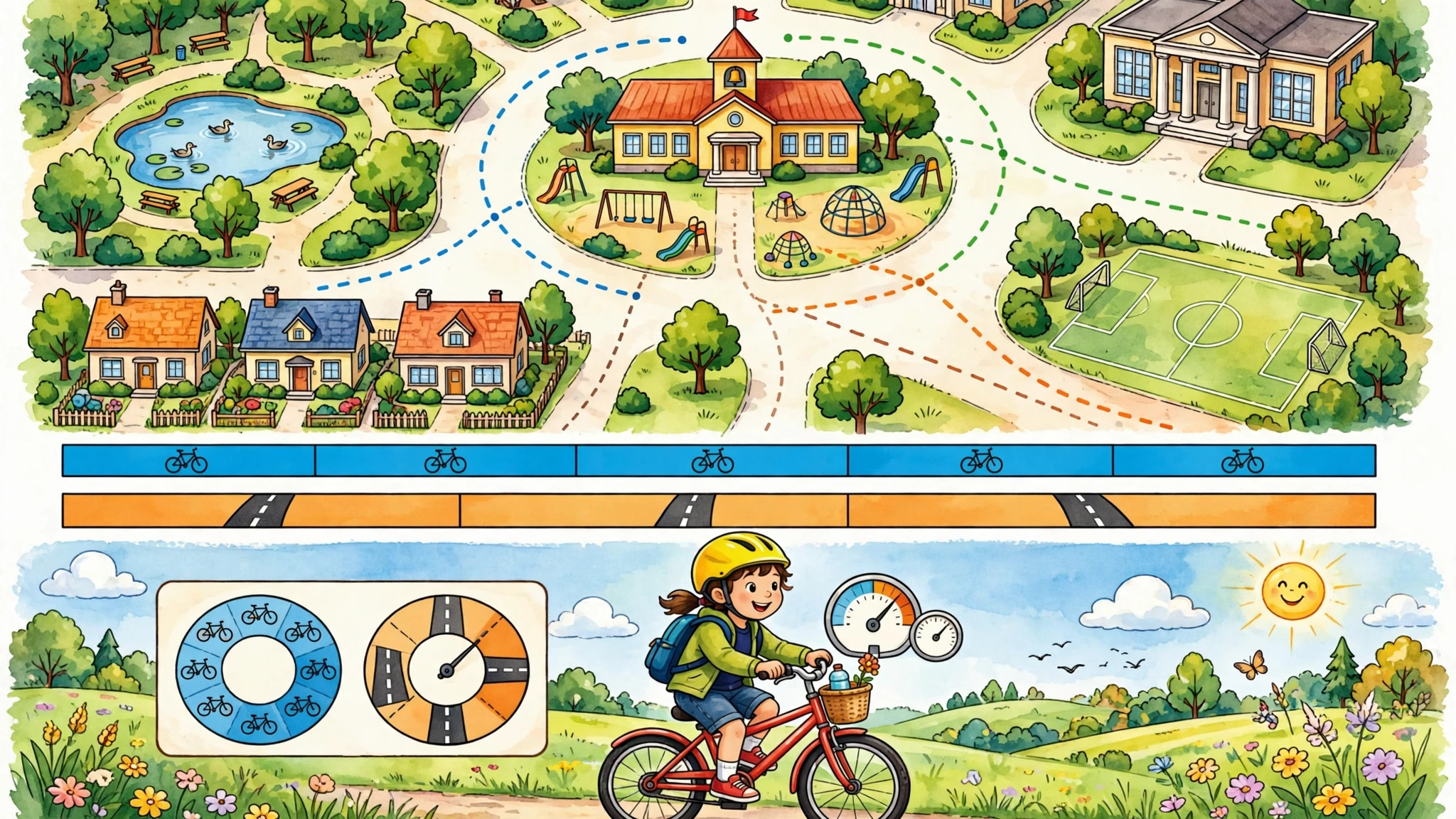
📏🌍
Some things are close. Your nose is close to your eyes! 👃👀
Some things are far away. The Moon is very, very far! 🌙
We use rulers and steps to see how far things are. 👣
What Is Distance?
Distance is how far apart two things are. Your hand to your elbow? That is a distance! The park to your house? That is a distance too. Everything in the world has space between it, and distance is how we talk about that space.
How Do We Measure It?
People use different tools. A ruler measures small things like pencils. A tape measure works for rooms. For really big distances, like driving to Grandma's house, we use miles or kilometers. The number tells you how far!
Short vs. Long
An ant walks a few inches to find food. A plane flies thousands of miles across the ocean. The Sun is SO far away that light takes 8 whole minutes to reach us, and light is the fastest thing there is! ☀️✈️🐜
Try It!
How many steps is it from your bed to the kitchen? Count them! You just measured a distance. 👣
What Does "Distance" Really Mean?
Distance is the amount of space between two places or two objects. It sounds simple, but measuring it has been one of the biggest challenges in all of science. Ancient people started by using their own bodies: a "foot" was the length of a foot, and a "cubit" was the distance from your elbow to your fingertip. The problem? Everyone's body is a different size!
The Metric System to the Rescue
In 1799, France created the meter to solve this problem. One meter is the same everywhere in the world. We use centimeters (cm) for small things, meters (m) for rooms and buildings, and kilometers (km) for cities and countries. In the US, people also use inches, feet, and miles.
Distances You Can Imagine
Here are some distances to help you picture how big our world is:
- A grain of sand: about 0.5 millimeters wide
- A basketball court: 28.65 meters long
- New York to Los Angeles: about 3,944 km (2,451 miles)
- Earth to the Moon: about 384,400 km (238,900 miles)
- Earth to the Sun: about 150 million km (93 million miles)
Why Does Distance Matter?
Distance changes how long it takes to get somewhere and how much energy you need. Walking to school takes minutes. Flying across the country takes hours. Sending a spacecraft to Mars takes about 7 months! Understanding distance helps us plan trips, build roads, send packages, and even explore space. 🚀
Distance: More Than Just "How Far"
Distance seems like one of the simplest ideas in science, but it connects to some of the deepest questions humans have ever asked. How big is the universe? How do we know? And what does "far" even mean when space itself is stretching?
Measuring the Unmeasurable
For most of history, people could only measure what they could physically reach. Then Greek mathematician Eratosthenes did something brilliant around 240 BCE: he measured the circumference of the entire Earth using nothing but shadows, angles, and the distance between two cities. His answer (about 40,000 km) was remarkably close to the real value of 40,075 km.
The Distance Ladder
Astronomers use a "cosmic distance ladder" to measure increasingly enormous distances. Each rung depends on the one below it:
- Radar: Bounce radio waves off nearby planets and time the echo. Works out to about 30 AU (astronomical units, where 1 AU = Earth-Sun distance).
- Parallax: Watch how a star appears to shift when Earth moves from one side of its orbit to the other. Like holding your thumb up and blinking one eye at a time. Works to about 10,000 light-years with modern instruments.
- Standard candles: Certain types of stars (Cepheid variables) and explosions (Type Ia supernovae) have known brightness. By comparing how bright they appear to how bright they actually are, you can calculate how far away they must be. Works to billions of light-years.
Light-Years: When Kilometers Are Not Enough
A light-year is the distance light travels in one year: about 9.46 trillion kilometers. The nearest star system, Alpha Centauri, is 4.37 light-years away. That means the light reaching your eyes from Alpha Centauri tonight actually left that star 4.37 years ago. When you look at distant galaxies, you are literally seeing the past.
Distance and Time
One of Einstein's most revolutionary insights was that distance and time are connected. If you could travel close to the speed of light, distances would literally shrink from your perspective (a phenomenon called length contraction). Two observers moving at different speeds will disagree on how far apart two events are. Distance, it turns out, is not as absolute as it seems.
Distance in Physics: Coordinate Systems and Metrics
In Euclidean geometry, distance between two points (x₁, y₁) and (x₂, y₂) in a plane is given by the Pythagorean formula. In three dimensions, we simply add a z-component. This seems straightforward, but it rests on an assumption: that space is flat and obeys Euclidean rules. General relativity showed that this assumption is wrong near massive objects.
In curved spacetime, distances are defined by a metric tensor, a mathematical object that tells you how to compute the interval between two nearby events. The Schwarzschild metric, which describes spacetime around a non-rotating mass, includes terms that make radial distances grow as you approach the mass. A ruler near a black hole measures more space per coordinate increment than a ruler far from one.
The Problem of Cosmological Distance
In an expanding universe, "distance" becomes genuinely ambiguous. Consider a galaxy whose light has traveled 10 billion years to reach us. There are at least three legitimate ways to define its distance:
- Light-travel distance: 10 billion light-years (the time the photons were in transit).
- Comoving distance: The distance "now," accounting for expansion that occurred while the light was traveling. This is larger, perhaps 15-20 billion light-years.
- Angular diameter distance: Based on how large the galaxy appears on the sky. Due to expansion geometry, very distant objects can actually appear larger than closer objects of the same physical size.
Parallax and the Parsec
The parsec (parallax arcsecond) is the distance at which 1 AU subtends an angle of 1 arcsecond. It equals about 3.26 light-years or 3.086 × 10¹³ km. ESA's Gaia mission (launched 2013, DR3 in 2022) has measured parallaxes for nearly 2 billion stars with microarcsecond precision, extending the parallax rung of the distance ladder to tens of kiloparsecs from the Sun and calibrating the Cepheid period-luminosity relation with unprecedented accuracy.
The Hubble Tension
One of the most active problems in cosmology is a disagreement in the measured value of the Hubble constant, H₀, which sets the expansion rate of the universe and therefore the relationship between a galaxy's redshift and its distance. Local measurements using Cepheids and Type Ia supernovae (the SH0ES project, led by Adam Riess) yield H₀ ≈ 73.0 ± 1.0 km/s/Mpc. Measurements from the cosmic microwave background (Planck satellite) using early-universe physics give H₀ ≈ 67.4 ± 0.5 km/s/Mpc. The discrepancy is now above 5σ, which in physics means it is very unlikely to be a statistical fluke.
The tension could indicate new physics beyond the standard ΛCDM model (perhaps early dark energy, modified gravity, or interactions in the dark sector), systematic errors in one or both measurement chains, or subtle issues in calibrating the distance ladder. The James Webb Space Telescope has been used to cross-check Cepheid measurements and has so far confirmed the SH0ES results, making systematic error less likely. This remains an open problem.
Distance at the Quantum Scale
At scales below the Planck length (approximately 1.616 × 10⁻³⁵ meters), our current theories of physics break down. Quantum mechanics suggests that spacetime itself might not be smooth at these scales, and the very concept of "distance between two points" might lose its meaning. Several approaches to quantum gravity (loop quantum gravity, string theory, causal set theory) propose different modifications to the classical notion of distance at ultra-short scales, but none has been experimentally tested.
A Concept That Shaped Civilization
Distance measurement is one of humanity's oldest intellectual projects. The need to know "how far" drove the development of geometry (literally "earth measurement"), navigation, cartography, and ultimately modern physics. Every improvement in our ability to measure distance has reshaped how humans live: accurate land surveying enabled property law; celestial navigation opened global trade; radar won wars; and satellite positioning now guides billions of daily decisions from ride-hailing to precision agriculture.
The History of the Meter
The meter has been redefined four times. Originally (1793), it was one ten-millionth of the distance from the North Pole to the equator along the meridian through Paris, measured by the geodetic survey of Delambre and Méchain. In 1889, it became the distance between two scratches on a platinum-iridium bar kept in a vault near Paris. In 1960, it was redefined as 1,650,763.73 wavelengths of krypton-86 orange-red radiation. And since 1983, it has been defined by fixing the speed of light at exactly 299,792,458 m/s, so one meter is the distance light travels in 1/299,792,458 of a second. The shift is philosophically significant: distance is now defined through time and the speed of light, not through a physical artifact.
Eratosthenes and the Limits of Secondary Sources
The Eratosthenes story is widely told in children's science education, but the details are murkier than popular accounts suggest. His original work is lost; we know it through Cleomedes (who gives different numbers than Strabo). The distance between Alexandria and Syene (which Eratosthenes reportedly knew because Egyptian surveyors, or bematists, had paced it) is variously reported as 5,000 stadia, but the length of the stadium he used is uncertain, with plausible values ranging from 157.5 m to 185 m. Depending on which stadion you assume, his circumference estimate ranges from 39,375 km to 46,250 km, and the "remarkably accurate" narrative may be partly retroactive selection of the stadion length that gives the best answer.
The Cosmic Distance Ladder: Error Propagation Is the Story
The "cosmic distance ladder" is the scaffolding of techniques astronomers use to measure increasingly remote objects. What makes it both powerful and fragile is that each rung depends on the calibration of the rung below. Parallax calibrates Cepheid period-luminosity relations; Cepheids calibrate Type Ia supernovae; supernovae calibrate Hubble flow distances. An error at any rung propagates upward. The entire debate around the Hubble tension (the 5σ disagreement between local and CMB-derived values of H₀) is fundamentally a question about whether the distance ladder has a systematic error that compounds across rungs.
The Gaia mission has been transformative. By measuring parallaxes for ~1.8 billion stars with microarcsecond precision, it anchored the first rung of the ladder with far greater certainty. But Gaia introduced its own systematics: a global parallax zero-point offset of about -17 microarcseconds (Lindegren et al. 2021) that must be corrected for, and that correction depends on magnitude, color, and ecliptic latitude. The SH0ES team (Riess et al. 2022) used Gaia EDR3 parallaxes to recalibrate their Cepheid distances and found H₀ = 73.04 ± 1.04 km/s/Mpc, while Planck gives 67.4 ± 0.5. JWST observations of Cepheids in the same galaxies (Riess et al. 2024) confirmed that HST crowding effects were not biasing the Cepheid photometry, further tightening the case that the tension is real.
When Distance Breaks
General relativity teaches that distance is not a property of objects but of spacetime geometry. Near a black hole, the Schwarzschild metric makes "distance to the event horizon" depend on the observer's state of motion. For an infalling observer, the event horizon is a finite distance away and is crossed in finite proper time. For a distant observer watching the infalling one, the traveler asymptotically approaches the horizon but never appears to cross it. Both descriptions are correct in their respective reference frames.
Cosmological expansion adds another layer of complication. Two galaxies can be "moving apart" faster than light if the space between them is expanding fast enough. This does not violate special relativity, because it is not motion through space but expansion of space itself. The boundary of the observable universe (the particle horizon) is the surface beyond which light has not had time to reach us. The comoving distance to this surface is about 46.5 billion light-years, even though the universe is only 13.8 billion years old, because expansion has been stretching the photons' path while they travel.
Practical Distance Today: GPS and Beyond
The Global Positioning System determines your position (and therefore your distance from anything) by trilateration from at least four satellites, each broadcasting a precise time signal from an atomic clock. The distance to each satellite is computed from the signal's travel time multiplied by the speed of light. Achieving meter-level accuracy requires correcting for both special-relativistic time dilation (the satellites move fast, so their clocks tick slightly slower) and general-relativistic time dilation (the satellites are farther from Earth's gravity, so their clocks tick slightly faster). The net effect is that satellite clocks gain about 38 microseconds per day relative to ground clocks. Without this correction, GPS positions would drift by about 10 km per day.
Sources
- Delambre, J.B.J. Base du système métrique décimal. (1806-1810).
- Gulbekian, E. "The Origin and Value of the Stadion Unit." Revue des Études Anciennes, 89(3-4), 359-364 (1987).
- Riess, A.G. et al. "A Comprehensive Measurement of the Local Value of the Hubble Constant." The Astrophysical Journal Letters, 934, L7 (2022).
- Planck Collaboration. "Planck 2018 results. VI. Cosmological parameters." Astronomy & Astrophysics, 641, A6 (2020).
- Lindegren, L. et al. "Gaia Early Data Release 3: Parallax bias versus magnitude, colour, and position." Astronomy & Astrophysics, 649, A4 (2021).
- Riess, A.G. et al. "JWST Validates HST Distance Measurements." The Astrophysical Journal Letters, 962, L17 (2024).
- Ashby, N. "Relativity in the Global Positioning System." Living Reviews in Relativity, 6(1) (2003).
- Gaia Collaboration. "Gaia Data Release 3: Summary of the content and survey properties." Astronomy & Astrophysics, 674, A1 (2023).