
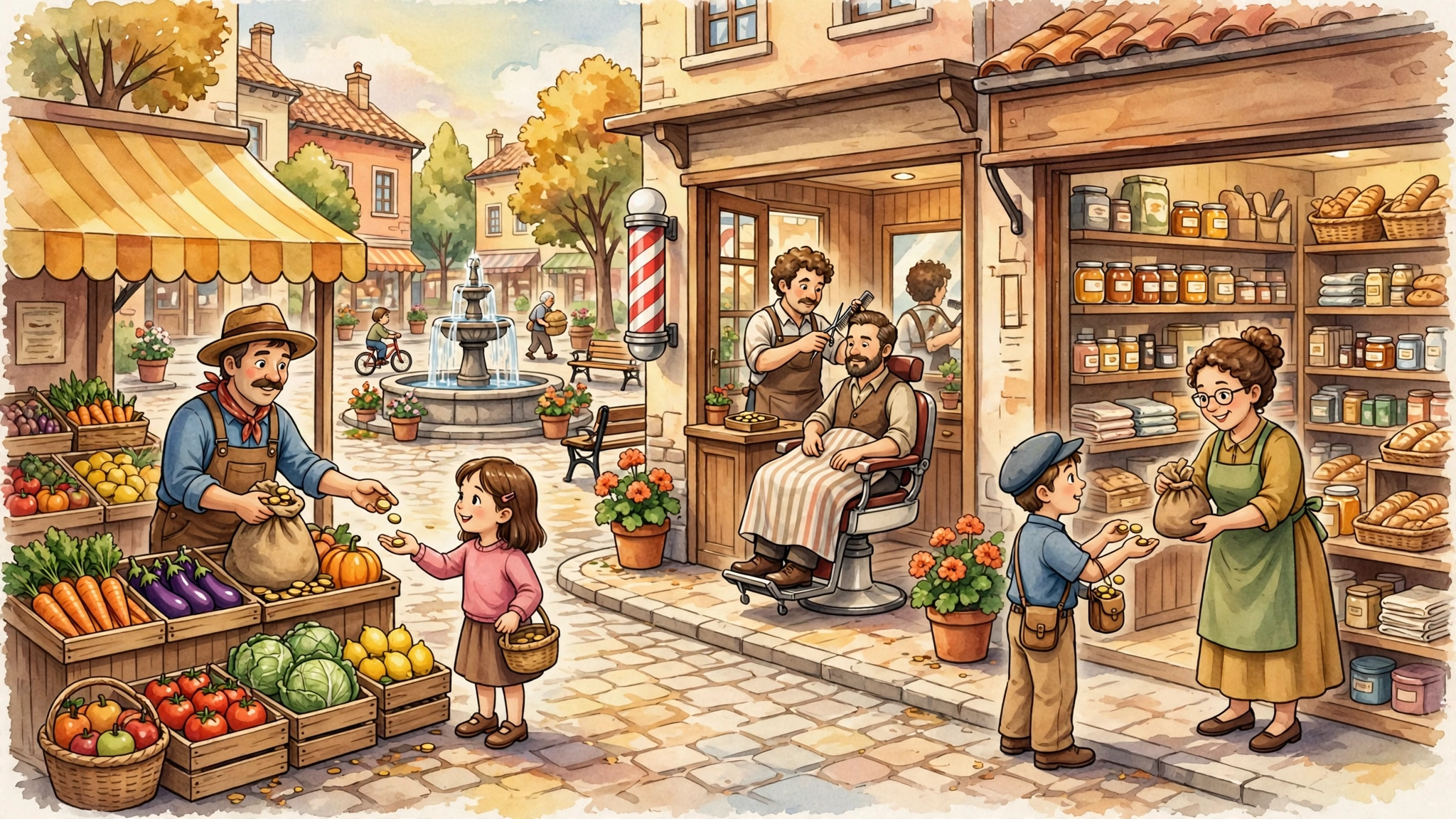
🛒 Some things you can TOUCH! An apple. A toy. A shoe. Those are called goods.
Some things people DO for you. A haircut. A doctor visit. Those are called services.
You use money to buy them! 💰
Goods are things you can hold in your hands. A book, a banana, a soccer ball, a shirt — those are all goods. Someone made them, and you can buy them.
Services are things people do for you. When a dentist cleans your teeth, that is a service. When a teacher helps you learn to read, that is a service too!
People go to work to make goods or do services. Then they use the money they earn to buy other goods and services. That is how the economy goes round and round! 🔄
Every single day, people all around the world are buying and selling things. Some of those things are goods — physical objects you can pick up, use, eat, or wear. Others are services — work that people do for you. Together, goods and services make up something called the economy.
What Are Goods?
Goods are physical things. Your breakfast cereal is a good. The chair you are sitting in is a good. The phone or computer you are reading this on is a good. Someone had to make each of those things, ship them, and sell them to you (or your family).
What Are Services?
Services are actions people perform for others. A doctor examines you — that is a service. A plumber fixes your sink — service. A bus driver takes you to school — service. You cannot put a service in a box, but it still has value.
Why Do We Need Money?
Money solves the bartering problem. Instead of finding someone who has what you want AND wants what you have, you just use money. The baker sells bread for money. Then the baker uses that money to pay the barber for a haircut. Money keeps everything moving.
Supply and Demand
Have you ever noticed that some things cost more than others? That is because of supply and demand. If lots of people want something (high demand) but there is not much of it (low supply), the price goes up. If nobody wants something, the price drops. It is like a seesaw!
The economy is the system humans invented to answer three fundamental questions: What should we make? How should we make it? Who gets it? The answers revolve around two categories: goods (tangible products) and services (intangible work performed for others).
Goods: From Raw Materials to Your Hands
Goods pass through a chain before they reach you. Raw materials (wood, cotton, iron ore) are harvested or mined. Manufacturers turn them into products (furniture, clothing, steel beams). Distributors move those products around the country or the world. Retailers sell them to you. Each step adds cost — and value.
Services: The Invisible Economy
In the United States and most wealthy countries, services make up the majority of the economy — roughly 77% of U.S. GDP. That includes healthcare, education, banking, entertainment, software, legal work, and transportation. The shift from a goods-heavy to a service-heavy economy accelerated throughout the 20th century and continues today.
The History of Money
Before money, people bartered. But barter requires a "double coincidence of wants" — both people must want what the other has. Money solved this problem. Early money included shells (cowrie shells in Africa and Asia), salt (the word "salary" comes from the Latin salarium, possibly linked to salt), and metal coins (first standardized in Lydia, modern-day Turkey, around 600 BCE).
Paper money appeared in China during the Tang Dynasty (~7th century CE). Today, most money is not even physical — it is digital numbers in bank computers.
Imagine a town has 100 people who each want to buy a winter coat. If only 50 coats are available (supply < demand), sellers can charge higher prices because buyers compete for the limited coats. If 200 coats are available (supply > demand), sellers must lower prices to attract buyers. The equilibrium price is where the amount people want to buy equals the amount available to sell.
Trade: Why Countries Buy and Sell to Each Other
No country can efficiently make everything its people need. Saudi Arabia has oil but limited farmland. Japan has advanced manufacturing but few natural resources. Trade lets each country focus on what it does best — economists call this comparative advantage — and buy the rest from others. Global trade in goods and services exceeded $31 trillion in 2023.
The Role of Entrepreneurs
An entrepreneur is someone who sees a need (demand) and creates a good or service to fill it. Every business — from a kid's lemonade stand to Apple Inc. — started with someone noticing a gap between what people wanted and what was available.
Economics is, at its core, the study of how societies allocate scarce resources. Goods and services are the outputs of that allocation — the tangible and intangible products that satisfy human wants and needs. Understanding how they are produced, distributed, priced, and consumed is the foundation of economic literacy.
The Four Factors of Production
Every good or service requires four inputs, which economists call the factors of production:
- Land — natural resources (oil, water, timber, minerals, fertile soil)
- Labor — human work, both physical and intellectual
- Capital — tools, machinery, factories, technology (not money itself, but what money buys)
- Entrepreneurship — the ability to combine the other three factors, take risks, and innovate
The relative availability and cost of these factors determine what a nation produces. Countries with abundant labor but limited capital (like many developing economies) tend to export labor-intensive goods (textiles, agricultural products). Countries with abundant capital (like Germany, Japan, or the U.S.) tend to export capital-intensive goods and services (machinery, software, financial services).
GDP: Measuring the Economy
Gross Domestic Product (GDP) measures the total market value of all final goods and services produced within a country in a given time period. The U.S. GDP in 2024 was approximately $28.8 trillion. China's was roughly $18.5 trillion. GDP per capita (GDP divided by population) is a rough proxy for average standard of living.
C = Consumer spending on goods and services (~68% of U.S. GDP)
I = Business investment (factories, equipment, inventory)
G = Government spending
X − M = Net exports (exports minus imports)
When consumer spending drops (as it did in 2008 and 2020), GDP contracts. This is called a recession.
Market Structures
The price and availability of goods and services depend heavily on market structure:
- Perfect competition: Many sellers, identical products, no single seller controls the price (close example: commodity wheat)
- Monopolistic competition: Many sellers, differentiated products (restaurants, clothing brands)
- Oligopoly: Few dominant sellers (airlines, wireless carriers, auto manufacturers)
- Monopoly: One seller controls the market (local utilities, patented drugs during exclusivity periods)
The Service Economy and the Knowledge Economy
The transition from manufacturing to services is one of the defining economic shifts of the past century. In 1950, manufacturing accounted for ~27% of U.S. GDP; by 2024, it was ~11%. Services grew from ~50% to ~77%. Within services, the fastest-growing sectors are information technology, healthcare, and professional/business services — collectively called the knowledge economy.
This shift has profound implications for labor markets. Manufacturing jobs paid middle-class wages to workers without college degrees. Many service-sector jobs are either high-paying (software engineering, medicine, finance) or low-paying (food service, retail, home health aides), contributing to what economists call the "hollowing out" of the middle class.
International Trade Theory
David Ricardo's theory of comparative advantage (1817) demonstrated that trade benefits both parties even when one country is more efficient at producing everything. The key insight: what matters is not absolute efficiency but opportunity cost — what you give up to produce something. If the U.S. gives up fewer units of software to produce one airplane than Brazil does, and Brazil gives up fewer airplanes to produce one unit of coffee, both benefit from specialization and trade.
Modern trade theory (Krugman, 1979) adds that economies of scale and consumer preference for variety also drive trade. Countries with similar economies (e.g., the U.S. and Germany) trade heavily with each other not because of resource differences but because each produces differentiated goods that consumers in the other country want.
- Smith, Adam, The Wealth of Nations, 1776.
- Ricardo, David, On the Principles of Political Economy and Taxation, 1817.
- Krugman, Paul, "Increasing Returns, Monopolistic Competition, and International Trade," Journal of International Economics, 1979.
- Bureau of Economic Analysis, "GDP by Industry," U.S. Department of Commerce, 2024.
- World Trade Organization, "World Trade Statistical Review 2024."
This article was requested by a Cookie Club reader who spelled it "GODDS AND SERVISES" — and honestly, that enthusiasm deserves the best explanation we can write. Goods and services are the building blocks of economic thinking, and they touch every part of our daily lives in ways most adults take for granted.
Why This Matters for Kids
Financial literacy starts with understanding what an economy is. Before kids can understand saving, investing, or budgeting, they need to grasp the basic loop: people make things (goods) or do things (services), exchange them using money, and the whole system depends on trust and cooperation. A child who understands supply and demand at age 8 has a conceptual scaffold that will serve them through every economic decision they ever make.
Teaching Economics at Home
The grocery store is the world's best economics classroom. Point out prices and ask why one brand costs more than another. Talk about the workers who grew the food, drove the trucks, stocked the shelves — each providing a service. An allowance system (especially one where kids can earn extra through chores) naturally teaches the relationship between labor and income.
Lemonade stands and bake sales are not just cute — they expose kids to production costs, pricing, marketing, competition, and profit. If the neighbor kid also sets up a lemonade stand, suddenly supply and demand is not abstract.
The Modern Economic Landscape
The shift from goods to services has accelerated dramatically. The "gig economy" (Uber, DoorDash, Fiverr) blurs the line between employer and contractor. The "creator economy" (YouTube, TikTok, Substack) turns individual people into service businesses. And the rise of subscription models (Netflix, Spotify, SaaS products) has changed how we pay for services — from one-time purchases to recurring fees.
For parents, these shifts mean the economic world our kids will inherit looks very different from the one we grew up in. Teaching the fundamentals — goods, services, supply, demand, trade, money — gives kids a framework flexible enough to navigate whatever comes next.
Common Misconceptions
"The economy" = the stock market. Nope. The stock market is one part of the economy. GDP, employment, consumer spending, trade balances, and the production of goods and services are all part of the picture.
Services are less "real" than goods. Services now make up ~77% of U.S. GDP. A surgeon performing an operation, a teacher educating a classroom, or a software engineer building an app are all creating enormous value — you just cannot put it in a box.
Money has always existed. Money is an invention, only about 5,000 years old. For most of human history, people bartered, gifted, or shared resources communally. Understanding that money is a tool — not a natural law — helps kids develop a healthier relationship with it.
💬 Talk About It
- For preschoolers: "When we go to the store, are we buying a good or a service? What about when we go to the barber?"
- For kindergartners: "If you had a store, what would you sell? Would it be a good or a service?"
- For elementary: "If only one store in town sells ice cream, can they charge whatever they want? What happens if a second store opens?"
- For middle school: "Why do you think the U.S. makes most of its money from services, not from making things in factories?"
- Mankiw, N. Gregory, Principles of Economics, 9th ed., Cengage, 2021.
- Bureau of Economic Analysis, "GDP by Industry," U.S. Department of Commerce, 2024.
- Graeber, David, Debt: The First 5,000 Years, Melville House, 2011.
- World Trade Organization, "World Trade Statistical Review 2024."