
Three Hearts, Blue Blood, and Eight Arms: The Octopus
March 23, 2026
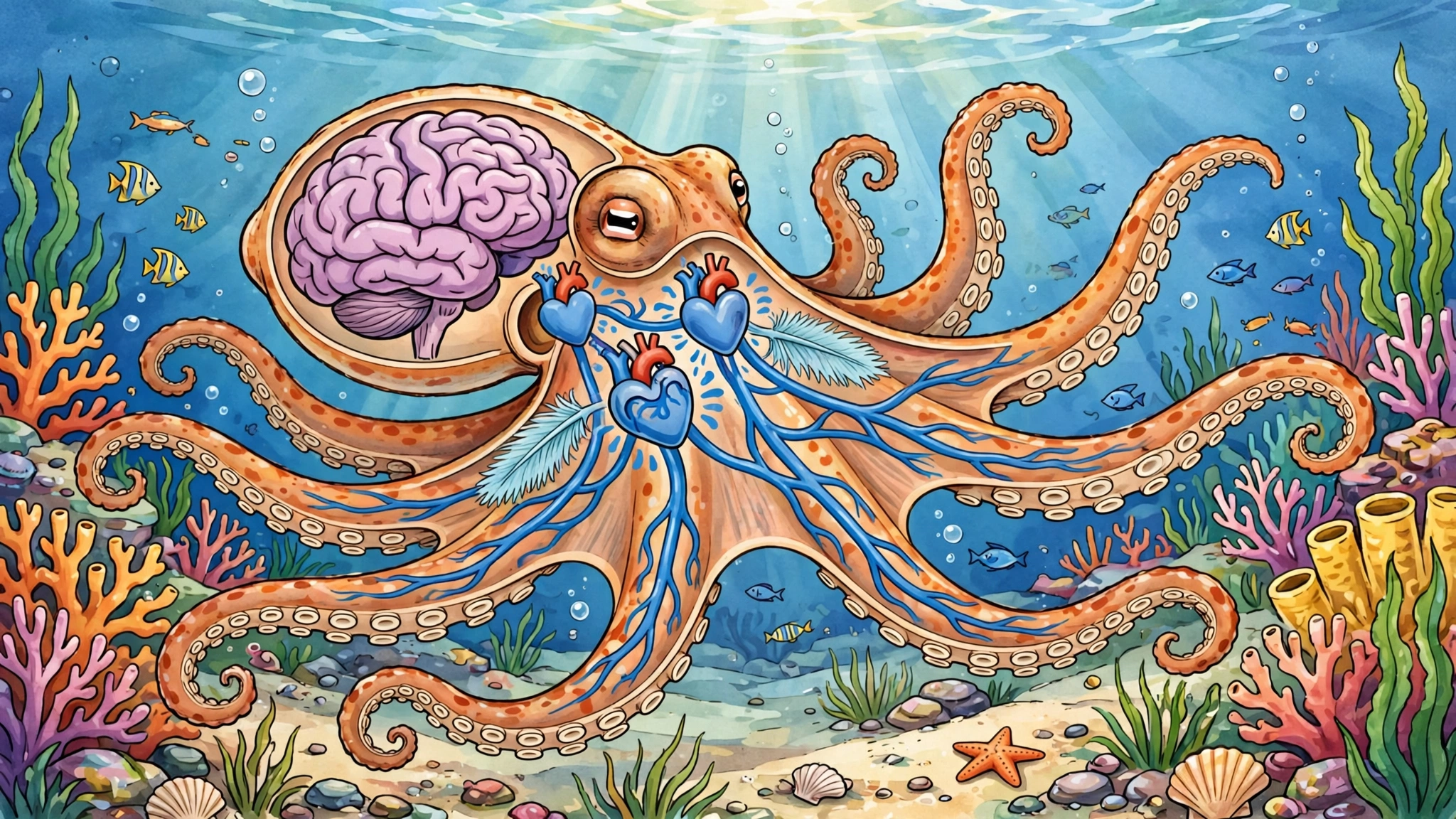
🐙 An octopus lives in the ocean!
It is soft and squishy. No bones! It has EIGHT long arms. Count them: 1, 2, 3, 4, 5, 6, 7, 8! 🤚🤚🤚🤚
Your blood is red. But guess what? An octopus has BLUE blood! 💙
It can change colors! Red! Brown! White! POOF! Just like magic! ✨
And it is SO smart. It can open jars and solve puzzles! 🧩
An octopus has THREE hearts. You only have one! 💙💙💙
An octopus lives in the ocean. It has a soft, squishy body and eight long arms. It has no bones at all! That means it can squeeze through really tiny spaces.
Octopuses are really smart. They can open jars. They can solve puzzles. They can even squirt water at people they do not like!
And they can change color in less time than it takes you to blink!
The octopus might be the most surprising animal in the ocean. Three hearts, eight arms covered in suckers, blue blood, and a brain that can solve problems most other animals cannot.
Three Hearts? Really?
Yes. Two small hearts pump blood to the gills (the parts that help it breathe underwater). The third, bigger heart pumps blood to the rest of the body. The main heart actually stops beating when the octopus swims. That is why octopuses prefer crawling!
Why Is Their Blood Blue?
Your blood uses iron to carry oxygen (which makes it red). An octopus uses copper instead (which turns blue). Copper works better than iron in cold, deep ocean water.
Smarter Than You Think
In aquariums, octopuses have been caught sneaking out of their tanks at night, crawling to other tanks to eat fish, and crawling back before morning. They can unscrew jar lids. They recognize individual human faces. One octopus kept short-circuiting a light by squirting water at it because the light annoyed her.
If you designed the strangest possible smart animal from scratch, you might end up with something like the octopus. Three hearts. Blue blood. Eight arms that can taste and think independently. A body with no bones. And a brain that, relative to body size, is the largest of any invertebrate on Earth.
The Three-Heart Circulatory System
Octopuses have a closed circulatory system (blood flows through vessels, not open body cavities). Two branchial hearts pump deoxygenated blood through the gills, where it picks up oxygen. The systemic heart then pumps oxygenated blood to the organs and muscles.
The systemic heart stops beating when the octopus swims, causing an oxygen debt that builds up quickly. This is why most octopuses prefer crawling to swimming: sustained swimming exhausts them.
Hemocyanin vs. Hemoglobin
Your blood is red because hemoglobin contains iron, which turns red when bound to oxygen. Octopus blood is blue because hemocyanin contains copper, which turns blue when oxygenated.
Hemoglobin (human): carries ~200 mL O₂ per liter of blood
Hemocyanin (octopus): carries ~40 mL O₂ per liter of blood
Hemocyanin is ~5x less efficient in warm water. But in cold, low-oxygen environments (deep ocean, polar seas), hemocyanin's oxygen-binding curve shifts to become more effective than hemoglobin.
Distributed Intelligence: 500 Million Neurons
An octopus has about 500 million neurons. For comparison, a dog has about 530 million and a cat about 250 million. But here is the strange part: two-thirds of those neurons are NOT in the brain. They are distributed throughout the eight arms.
Each arm has roughly 40 million neurons organized into ganglia (nerve clusters) that can process sensory information and execute movements independently. A severed octopus arm will continue to react to stimuli, grasp objects, and even pass food toward where the mouth would be. The central brain appears to issue high-level commands ("grab that crab"), while each arm independently solves the movement problem.
Color Change: Chromatophores
Octopus skin contains thousands of chromatophores, tiny sacs of pigment surrounded by muscles. When the muscles contract, the sac expands and its color becomes visible. When they relax, the color fades. Each chromatophore is individually controlled by the nervous system. By activating different combinations, the octopus can produce complex patterns in milliseconds.
Below the chromatophores are iridophores (which reflect light to create metallic sheens) and leucophores (which scatter all wavelengths to produce white). Together, these three layers give octopuses one of the most sophisticated camouflage systems in the animal kingdom.
The octopus represents one of evolution's most radical experiments in intelligence. Separated from vertebrates by approximately 750 million years of evolution, cephalopods developed complex cognition through an entirely independent pathway, making the octopus the closest thing to an alien mind on Earth.
Convergent Evolution of Intelligence
Intelligence has evolved independently multiple times: in mammals, birds (corvids, parrots), and cephalopods. Each lineage found different solutions to the same problem. Mammals centralized neural processing in a layered cortex. Birds packed neurons at high density in a pallium without cortical layers. Octopuses distributed processing across a decentralized network.
The Octopus Nervous System Architecture
The central brain wraps around the esophagus (meaning food passes through the brain, which is why octopuses tear food into small pieces). It contains approximately 170 million neurons organized into 40 specialized lobes. The optic lobes alone contain about 120 million neurons, reflecting the dominance of vision.
The remaining ~330 million neurons reside in the arms, organized into a chain of ganglia. Zullo et al. (2009) demonstrated that arms continue to execute coordinated reaching movements even when surgically disconnected from the central brain, confirming that motor programs are stored locally.
Hemocyanin: Evolutionary Trade-offs in Oxygen Transport
Hemocyanin is a type-3 copper protein that binds oxygen cooperatively, similar to hemoglobin's cooperative binding. However, hemocyanin circulates freely dissolved in the hemolymph rather than packaged in red blood cells. This limits its concentration (and thus oxygen-carrying capacity) to about 40 mL O₂/L compared to hemoglobin's ~200 mL O₂/L.
The advantage emerges at low temperatures and low oxygen partial pressures. Hemocyanin's oxygen affinity increases as temperature drops, following a negative temperature coefficient of P₅₀. In the cold, hypoxic deep ocean, this property makes hemocyanin more effective than hemoglobin. However, it also makes cephalopods acutely sensitive to warming: a 2 degree C increase can reduce oxygen transport efficiency by 20-40%, making them among the most climate-vulnerable marine taxa.
The Consciousness Debate
The 2012 Cambridge Declaration on Consciousness included cephalopods among animals possessing "the neurological substrates that generate consciousness." The UK's 2022 Animal Welfare (Sentience) Act formally recognized octopuses as sentient beings.
Godfrey-Smith (2016) argued that the distributed nervous system may produce a fundamentally different form of consciousness, potentially involving multiple quasi-independent experiential streams. If each arm has its own sensory processing and decision-making capability, the question becomes: is the octopus one mind, or nine?
- Albertin, C.B. et al., "The octopus genome and the evolution of cephalopod neural and morphological novelties," Nature, 2015.
- Hochner, B., "An Embodied View of Octopus Neurobiology," Current Biology, 2012.
- Godfrey-Smith, P., Other Minds: The Octopus, the Sea, and the Deep Origins of Consciousness, 2016.
- Liscovitch-Brauer, N. et al., "Trade-off between Transcriptome Plasticity and Genome Evolution in Cephalopods," Cell, 2017.
- Zullo, L. et al., "Nonsomatotopic Organization of the Higher Motor Centers in Octopus," Current Biology, 2009.
The octopus sits at one of the most interesting intersections in biology: extreme intelligence in an organism that shares almost nothing with other intelligent animals. The last common ancestor between octopuses and humans lived approximately 750 million years ago.
The Intelligence Paradox
Octopuses live only 1 to 5 years. They are solitary. They do not raise their young, and they die shortly after mating (females stop eating while guarding eggs and waste away). There is no parental teaching, no social learning, no culture. Every octopus that opens a jar is figuring it out from scratch.
This makes octopus intelligence genuinely puzzling from an evolutionary standpoint. In most intelligent species (primates, corvids, cetaceans), intelligence coevolves with social complexity and long lifespans. Octopuses have neither. The leading hypothesis: they lost their ancestral shell roughly 140 million years ago and needed intelligence as a behavioral replacement for physical armor. A naked, soft-bodied animal in an ocean full of predators must be clever to survive.
The Consciousness Question
The 2012 Cambridge Declaration on Consciousness included cephalopods among animals possessing "the neurological substrates that generate consciousness." The UK's 2022 Animal Welfare (Sentience) Act formally recognized octopuses as sentient beings, banning practices like boiling them alive.
Peter Godfrey-Smith's Other Minds (2016) makes the case that the distributed nervous system may produce a fundamentally different form of consciousness. If 350 million of 500 million neurons reside in the arms, and each arm can independently taste, grasp, and make decisions, the question becomes: is the octopus one mind, or nine? This is not merely philosophical. It has practical implications for how we assess pain and welfare in these animals.
Climate Vulnerability
Hemocyanin's negative temperature coefficient makes cephalopods acutely sensitive to ocean warming. A 2°C increase can reduce oxygen transport efficiency by 20-40%. As oceans warm, octopuses are already shifting poleward. Antarctic species like the glass octopus (Vitreledonella richardi) may have nowhere colder to go.
Paradoxically, short generation times give octopuses faster evolutionary adaptation rates than many marine vertebrates. Some marine biologists predict cephalopods may become relative "winners" in degraded ocean ecosystems where their competitors and predators decline faster than they do.
Aquarium Ethics and Enrichment
Public aquariums that keep octopuses now use enrichment protocols (puzzles, novel objects, live prey hunts) comparable to those for great apes. An under-stimulated octopus will attempt escape, dismantle equipment, and show stereotypic behaviors associated with stress. The Seattle Aquarium reported an octopus that learned to unscrew a childproof container after watching a keeper do it once. Staff at the University of Otago documented an octopus that consistently squirted water at a specific researcher it apparently disliked, while leaving others dry.
💬 Talk About It
- For preschoolers: "What would you taste if your fingers could taste?"
- For kindergartners: "What would your body be like without bones? Could you fit through a tiny hole?"
- For elementary: "What would life be like if you had to figure out everything from scratch, with no one to teach you?"
- For middle school: "If each arm can make its own decisions, who is really in charge? What does 'thinking' even mean?"
- Hochner, B., "An Embodied View of Octopus Neurobiology," Current Biology, 2012.
- Godfrey-Smith, P., Other Minds: The Octopus, the Sea, and the Deep Origins of Consciousness, 2016.
- Albertin, C.B. et al., "The octopus genome," Nature, 2015.
- Liscovitch-Brauer, N. et al., "Trade-off between Transcriptome Plasticity and Genome Evolution in Cephalopods," Cell, 2017.