
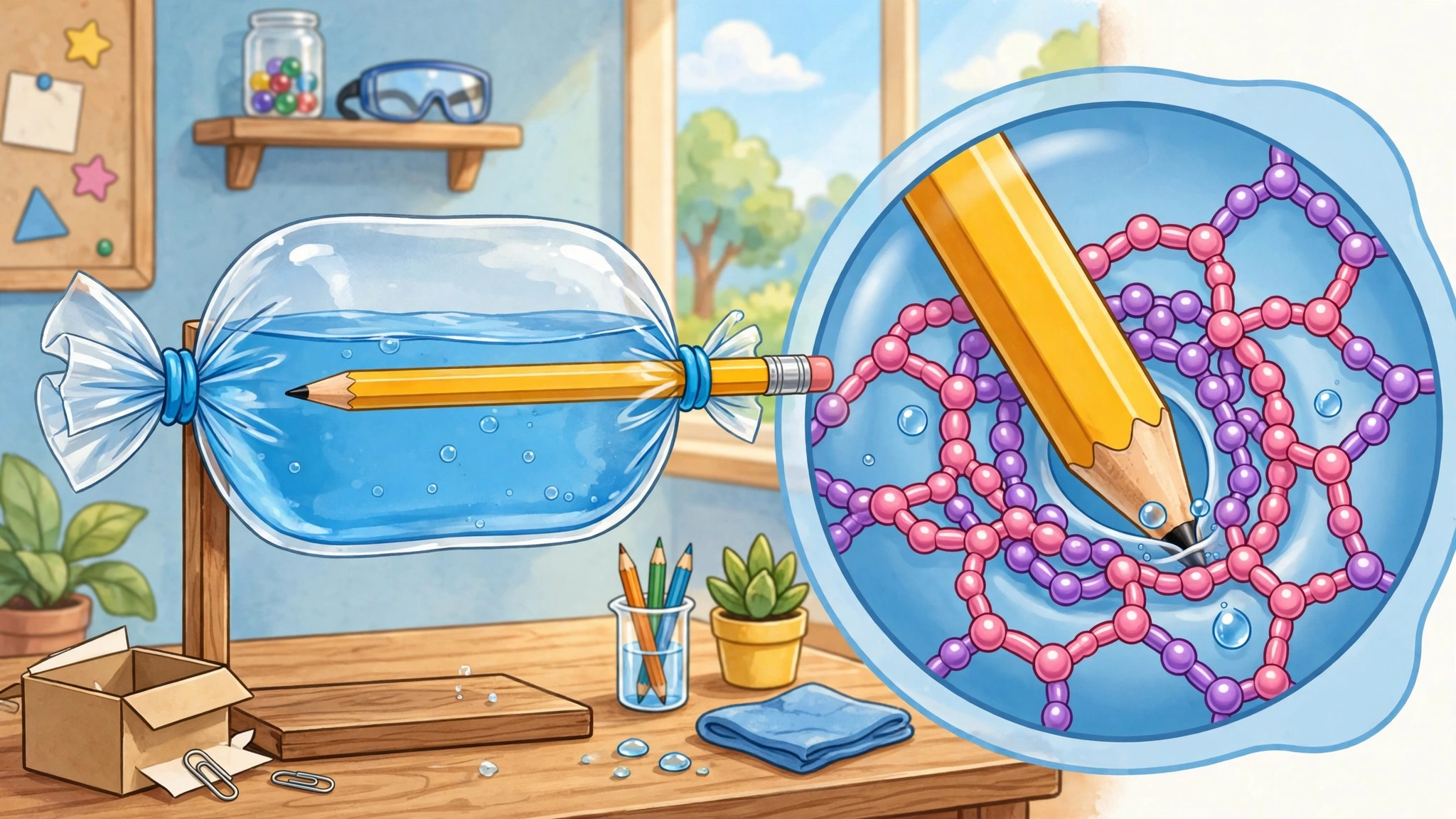
✏️💧😮
Fill a bag with water. Poke a pencil through it. No water comes out! 💦
The bag hugs the pencil tight. It keeps the water inside! ✏️
Try it at home with a grown-up. It is like magic! ✨
A Water Bag That Does Not Leak?
Fill a zip-lock bag with water. Now push a sharp pencil right through both sides. What happens? The water stays inside! It seems impossible, but it really works.
Why Does It Work?
The bag is made of a special material called plastic. When the pencil pokes through, the plastic squeezes around the pencil really tightly, like a hug. That tight hug keeps the water from leaking out.
What You Need
All you need is a zip-lock bag, some water, and a few sharpened pencils. Fill the bag about three-quarters full. Hold it over a sink, and push the pencil through slowly but firmly. Ask a grown-up to help!
What Happens When You Pull the Pencil Out?
Here is the fun part: when you pull the pencil out, the water DOES leak! The bag cannot close the hole by itself. The pencil was the plug all along!
The Trick That Is Not a Trick
Here is something that looks like a magic trick but is actually pure science. Take a zip-lock plastic bag, fill it with water, and push a sharpened pencil straight through both sides. The water does not leak. You can push five or six pencils through the same bag and it still holds the water inside.
What Is the Bag Made Of?
Zip-lock bags are made from a type of plastic called polyethylene (say: polly-ETH-uh-leen). Polyethylene is made of really long, stringy molecules called polymers. Think of a bowl of cooked spaghetti noodles. The noodles are all tangled up together, and if you push a chopstick through the pile, the noodles slide around the chopstick and fill in the gaps.
Why No Leak?
When the sharp pencil tip breaks through the plastic, the polymer chains do not shatter apart. Instead, they stretch and wrap around the pencil. They form a tight seal, pressing against the pencil's smooth surface. As long as the pencil stays in place, water cannot squeeze past.
Try It Yourself
You will need: a zip-lock bag (not the slider kind), water, and 3 to 6 sharpened pencils. Fill the bag about three-quarters full and seal it shut. Hold it over a sink or go outside. Push each pencil through one side of the bag, through the water, and out the other side in one smooth, firm motion. Do not wiggle it. Count how many pencils you can fit before anything goes wrong!
Polymer Science in a Zip-Lock Bag
The pencil-through-a-water-bag demonstration is one of the most popular science fair experiments in the world, and for good reason: it is cheap, dramatic, and genuinely illustrates something important about materials science. The explanation comes down to a single concept: polymer chain mobility.
What Are Polymers?
A polymer is a molecule made of repeating subunits called monomers, linked together in long chains. Polyethylene, the plastic in zip-lock bags, is one of the simplest: its monomer is ethylene (C₂H₄), and a single chain can contain 10,000 to 100,000 repeating units. The chains are not rigidly locked in place. They can slide past each other, stretch, and rearrange, especially in low-density polyethylene (LDPE), which has significant branching that prevents tight crystalline packing.
Why LDPE Works (and Other Plastics Might Not)
Zip-lock bags are made from LDPE. Its branched structure means the chains are loosely packed with lots of amorphous (disordered) regions. When a sharp pencil penetrates, the chains in those amorphous regions can flow around the intruder and press against it. A rigid, highly crystalline plastic, like a CD case (polycarbonate) or a water bottle (PET), would crack instead of sealing because its chains are locked into ordered lattice structures that cannot rearrange.
The Role of the Sharp Tip
The pencil must be sharp. A dull or blunt object concentrates force over a larger area, tearing chains apart rather than pushing between them. A sharp tip applies force to a tiny area, spreading the chains aside gradually. This is the same reason a needle slides through fabric but a finger pushes the whole cloth.
Why Pulling It Out Causes a Leak
When you remove the pencil, the polymer chains that were pressed against it spring back slightly, but they have been permanently displaced. They cannot re-fuse into a continuous sheet. The result is a hole with no plug, and water pours through. This tells us something important: the seal was mechanical (pressure-based), not chemical (the chains did not bond to the pencil).
Variations to Test
Try the experiment with different bag types (slider bags, thicker freezer bags, sandwich bags), different pointed objects (bamboo skewers, ball-point pens, nails), and at different temperatures. Cold bags are stiffer and may leak more. Freezer bags are thicker LDPE and may seal even better. Metal objects may not work as well because their smoother surfaces create less friction against the polymer.
Polymer Mechanics and the Pencil Experiment
The pencil-through-a-water-bag demonstration is a useful entry point into polymer mechanics, specifically the distinction between elastic deformation, plastic deformation, and fracture in semicrystalline thermoplastics. What appears to be a simple party trick actually involves several material properties working in concert: chain mobility in amorphous regions, stress distribution at the puncture site, and the self-sealing behavior of flexible polymer matrices.
LDPE Microstructure
Low-density polyethylene (LDPE), the material in standard zip-lock bags, has a density of 0.910-0.940 g/cm³ and a melting point around 105-115°C. Its defining structural feature is extensive long-chain branching: roughly 20-30 branches per 1,000 carbon atoms in the backbone. This branching prevents efficient chain packing, producing a material that is 40-50% crystalline (the crystalline lamellae are typically 5-15 nm thick) and 50-60% amorphous.
Stress Concentration and Puncture Mechanics
When a sharp pencil tip contacts the bag, the applied force concentrates on a point with an area of roughly 0.1-0.5 mm². The local stress (force/area) exceeds the yield strength of LDPE (approximately 8-12 MPa), causing plastic deformation. The chains in the amorphous regions flow radially outward from the puncture point, stretching but not breaking. As the pencil shaft follows, it slides through a channel of displaced chains that press inward due to their elastic recovery tendency, creating a radial compressive stress against the pencil surface.
The seal holds as long as the radial compressive stress exceeds the hydrostatic pressure of the water inside the bag. For a typical bag held at arm's height, the water column creates roughly 500-1,000 Pa (0.005-0.01 atm), which is orders of magnitude below the elastic restoring force of the displaced polymer.
Why Temperature Matters
At higher temperatures, chain mobility increases and the seal may actually improve, as the amorphous chains flow more readily around the pencil. At low temperatures (approaching 0°C for water-filled bags), the reduced chain mobility makes the polymer stiffer, and the puncture is more likely to produce micro-cracks that propagate as fracture lines rather than clean, self-sealing channels. This is a practical demonstration of the ductile-to-brittle transition in polymers.
Comparison with Other Polymers
The experiment fails with most other common plastics:
- PET (polyethylene terephthalate): High Tg (~67°C) means the amorphous regions are glassy at room temperature. Puncture produces brittle fracture and cracking.
- Polycarbonate: Despite being amorphous and tough, its rigid bisphenol-A backbone limits the flow needed for self-sealing. Puncture creates a clean hole.
- PVC (rigid): High Tg (~80°C) and limited chain mobility. Shatters or cracks on puncture.
- Natural rubber (vulcanized): Actually works similarly to LDPE because its cross-linked network can deform elastically around a puncture. Latex balloons demonstrate a related effect, though the cross-links limit the maximum puncture size.
Engineering Relevance
The principle behind this experiment has engineering applications. Self-sealing fuel tanks in military aircraft use a similar concept: layers of natural rubber or specialized elastomers swell and seal around bullet holes when exposed to fuel. Automotive run-flat tire inserts and self-sealing tire liners exploit the same radial compression mechanism. Understanding puncture mechanics in polymers also matters for food packaging integrity, biomedical implant design, and geomembrane liners used in landfills.
A Deceptively Rich Demonstration
The pencil-through-a-water-bag experiment is a staple of children's science shows, YouTube channels, and elementary school classrooms. It is also, somewhat surprisingly, a legitimate window into polymer physics, materials science, and engineering design. The underlying mechanism touches on concepts that occupy working materials scientists: semicrystalline morphology, viscoelastic deformation, fracture mechanics, and the ductile-to-brittle transition in thermoplastics.
The Material: Low-Density Polyethylene
Standard zip-lock bags (Ziploc, Glad, store brands) are made from low-density polyethylene (LDPE), first synthesized accidentally by Eric Fawcett and Reginald Gibson at ICI in 1933 under extreme pressure (1,700 atm) during ethylene polymerization experiments. LDPE's defining characteristic is extensive long-chain branching, with approximately 20-30 branch points per 1,000 backbone carbons. These branches prevent the tight, parallel chain packing found in high-density polyethylene (HDPE) and result in a material that is only 40-50% crystalline.
The practical consequence: LDPE is soft, flexible, and stretchy at room temperature. Its glass transition temperature (Tg) is approximately -120°C, meaning that at any temperature a human would encounter, the amorphous regions of LDPE are in a rubbery, mobile state. The chains can slide, stretch, and rearrange under modest stress. This molecular-level flexibility is the entire reason the pencil experiment works.
Puncture Mechanics in Detail
When a sharpened pencil penetrates the bag, several things happen simultaneously. The sharp tip concentrates applied force onto a sub-millimeter contact area, producing local stresses that exceed LDPE's yield strength (8-12 MPa). The polymer chains in the amorphous regions undergo plastic (permanent) deformation, flowing radially outward from the puncture. Critically, they do not fracture. The chains maintain their integrity and simply rearrange around the intruder.
As the pencil shaft follows the tip through, the displaced chains press inward against the pencil due to elastic recovery. They cannot return to their original configuration because the pencil occupies that space, so they exert a persistent radial compressive stress on the pencil surface. This compressive stress is the seal. The hydrostatic pressure of the water inside the bag (typically 500-2,000 Pa, depending on fill level and orientation) is far too low to overcome this mechanical clamping force.
This mechanism is mechanical, not chemical. The polymer does not bond to the pencil. When you remove the pencil, the chains spring back partially but cannot re-fuse across the gap, leaving a permanent hole. The demonstration thus illustrates the critical difference between reversible elastic deformation and irreversible plastic deformation in semicrystalline polymers.
Why Other Plastics Fail
The experiment is specific to LDPE and a few related materials. Most common plastics either crack or shatter on puncture because their chains lack the mobility to flow around the penetrating object. PET (water bottles), polycarbonate (safety glasses), and rigid PVC all have glass transition temperatures well above room temperature, meaning their amorphous regions are in a rigid, glassy state. Applied stress produces fracture rather than flow.
Interestingly, natural rubber latex (vulcanized) exhibits a related self-sealing behavior, which is why balloons can sometimes survive thin needle punctures if done carefully. The cross-linked rubber network deforms elastically around the needle and presses against it. However, the cross-links limit how much the material can flow, so the range of puncture sizes that self-seal is narrower than in LDPE.
Engineering Applications
The self-sealing principle has serious engineering applications. Military self-sealing fuel tanks, used since World War II, incorporate layers of natural rubber or synthetic elastomers (typically vulcanized nitrile rubber) that swell on contact with aviation fuel and compress around bullet or shrapnel perforations. Modern designs use multi-layer composites with fuel-activated sealant layers that can close holes up to 12.7 mm (0.50 caliber) in diameter. The B-17 Flying Fortress was one of the first aircraft to use self-sealing fuel cells extensively, and the technology is credited with significantly improving bomber survivability over Europe.
Run-flat tire technology uses a related approach. Some designs incorporate a sealant layer inside the tire that flows into puncture wounds under centrifugal force, while others use a rigid sidewall support ring that allows continued driving (at reduced speed) after complete pressure loss. Continental's ContiSeal technology, for example, uses a viscous butyl-rubber-based sealant layer that can permanently close punctures from objects up to 5 mm in diameter.
In biomedical engineering, the puncture mechanics of polymers are relevant to the design of self-healing hydrogels for drug delivery, vascular catheter ports that must reseal after repeated needle insertions, and geomembrane liners (HDPE sheets, typically 1.5-2.5 mm thick) used in landfills and mining operations where long-term puncture resistance is critical.
Doing the Experiment Well
For parents running this with kids, a few practical notes. Use a standard zip-lock bag (not slider closure, which has a thicker, stiffer track that can crack). Fill about three-quarters full. Use freshly sharpened wooden pencils (not mechanical pencils, not pens with ink that will leak). Push in one continuous, firm motion; do not hesitate or wiggle midway, which creates micro-tears. Do it over a sink or outside. Cold tap water works fine. You can typically get 5-7 pencils through a standard sandwich bag before the cumulative stress causes tearing. Freezer bags, being thicker, handle more.
For a deeper experiment: try at different water temperatures, compare LDPE bags to HDPE bags (translucent grocery bags), and test different pointed objects (bamboo skewers, which are rougher; nails, which are smoother; ball-point pens, which are blunter). Each variation changes one variable and reveals something about how the seal works.
Sources
- Peacock, A.J. Handbook of Polyethylene: Structures, Properties, and Applications. Marcel Dekker (2000). [LDPE structure and branching]
- Ward, I.M. and Sweeney, J. Mechanical Properties of Solid Polymers. Wiley, 3rd ed. (2012). [Viscoelasticity, yield, fracture]
- Strobl, G.R. The Physics of Polymers. Springer, 3rd ed. (2007). [Semicrystalline morphology and chain mobility]
- McEvoy, M.A. and Correll, N. "Materials that couple sensing, actuation, computation, and communication." Science 347(6228):1261689 (2015). [Self-healing materials overview]
- Tobolsky, A.V. Properties and Structure of Polymers. Wiley (1960). [Foundational polymer mechanics]
- Federation of American Scientists. "Self-Sealing Fuel Cells." fas.org. [Military fuel tank technology history]
- Continental AG. "ContiSeal Technology." continental-tires.com. [Self-sealing tire sealant specifications]