
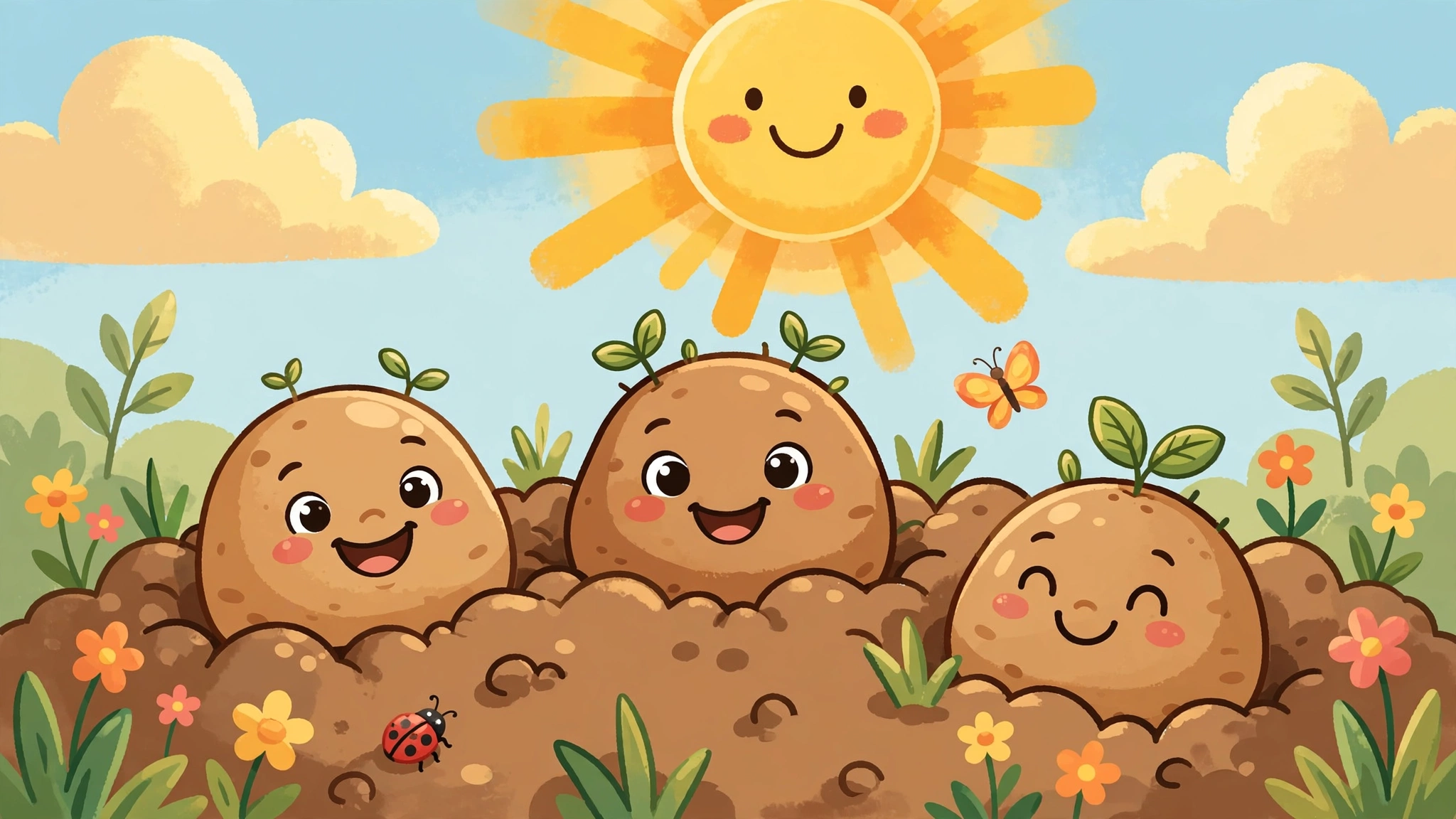
🥔🌱😋
Potatoes grow under the ground! Farmers dig them up. 🌍
You can bake them, mash them, or make fries! 🍟
Potatoes come in many colors. Some are yellow, red, or even purple! 💜
What Is a Potato?
A potato is a round, bumpy vegetable that grows underground. It is not a root! It is actually a swollen part of the plant's stem that stores food for the plant.
Where Do Potatoes Come From?
Potatoes first grew in South America, high up in the mountains. People there have been eating potatoes for thousands of years. Now potatoes grow all over the world!
So Many Ways to Eat Them
You can boil potatoes, bake them, fry them, roast them, or mash them into soft fluffy piles. French fries, baked potatoes, potato chips, and mashed potatoes are all made from the same vegetable!
Eyes on a Potato?
Have you ever seen little bumps on a potato? Those are called "eyes." If you put a potato in dirt, little green sprouts grow out of the eyes and a whole new potato plant appears!
The Underground Wonder
Potatoes are one of the most important foods in the world. People in almost every country eat them. But here is something surprising: the part we eat is not a root. It is a tuber, which is a special swollen stem that grows underground. The potato plant uses tubers to store starch, a type of energy, for growing new plants.
A Very Old Food
People in Peru and Bolivia started growing potatoes about 8,000 years ago in the Andes Mountains. Spanish explorers brought potatoes to Europe in the 1500s, but at first many Europeans were scared to eat them. Some people thought potatoes were poisonous because they are related to nightshade, a plant that really is dangerous. It took about 200 years before potatoes became popular in Europe.
How Potatoes Grow
Potatoes do not grow from seeds the way most plants do. Instead, you plant a piece of potato that has an "eye" (a small bud). The eye sprouts and grows into a whole new plant. Underground, the plant sends out special stems called stolons, and the tips of those stolons swell up into new tubers. One potato plant can produce 5 to 10 new potatoes!
Why Potatoes Matter
Potatoes feed more people than almost any other crop. They grow fast (only about 80 to 100 days), they grow in many different climates, and they pack a lot of nutrition into a small package. One medium potato has vitamin C, potassium, fiber, and plenty of energy from starch. Many countries rely on potatoes as a main food source.
More Than Just a Side Dish
The potato (Solanum tuberosum) is the world's fourth most important food crop, after rice, wheat, and corn. Roughly 1.3 billion people eat potatoes as a significant part of their diet. What makes potatoes remarkable from a biological and historical perspective is how much impact a single underground tuber has had on human civilization.
Tuber Biology
A potato tuber is not a root but a modified underground stem. The plant produces horizontal underground stems called stolons, and when conditions are right (shorter days, cooler soil temperatures), the tips of these stolons begin to swell as the plant diverts energy into starch storage. A single tuber is approximately 80% water and 20% dry matter, of which about 60-80% is starch.
The Andes Origin Story
Wild potato species still grow in the Andes Mountains of South America, from Venezuela to Chile. Indigenous farmers in what is now Peru and Bolivia domesticated the potato approximately 8,000-10,000 years ago, developing an astonishing diversity of cultivated varieties adapted to altitudes ranging from sea level to 4,500 meters. The Inca Empire built a food storage system around freeze-dried potatoes called chuño, produced by repeatedly freezing potatoes at night and stomping out the water during the day. Chuño could be stored for years.
The Great Famine
The most devastating event in potato history was the Irish Potato Famine (1845-1852). Ireland had become heavily dependent on a single potato variety, the Irish Lumper. When Phytophthora infestans, a water mold pathogen (technically an oomycete, not a true fungus), arrived from the Americas, it destroyed the crop almost completely across multiple growing seasons. The result was catastrophic: approximately 1 million people died and another 1 million emigrated, reducing Ireland's population by roughly 25%.
Nutrition
A medium-sized potato (about 150g) with skin provides approximately 110 calories, 26g of carbohydrates, 3g of protein, 2g of dietary fiber, 28% of the daily value of vitamin C, 12% of potassium, and significant amounts of vitamin B6, niacin, and manganese. Despite their starchy reputation, potatoes are reasonably nutrient-dense relative to their caloric content. The skin contains most of the fiber and a significant portion of the micronutrients.
Green Potatoes: A Real Danger
Potatoes produce glycoalkaloids (primarily solanine and chaconine) as a natural defense against insects and disease. When potatoes are exposed to light, they produce chlorophyll (turning green) and simultaneously increase glycoalkaloid production. At concentrations above 200 mg/kg, glycoalkaloids cause nausea, vomiting, and in extreme cases, neurological symptoms. Cutting away green portions and sprouts removes most of the risk. Cooking does not destroy glycoalkaloids.
The Crop That Changed Everything
The potato has a legitimate claim to being the most consequential food crop in modern history. Its introduction to Europe in the late 16th century, and its eventual adoption as a staple crop in the 18th and 19th centuries, contributed to a population boom that helped fuel the Industrial Revolution. Its catastrophic failure in Ireland demonstrated the existential risks of monoculture agriculture. And its biology, as a vegetatively propagated polyploid, makes it one of the most genetically complex crop species that breeders work with.
Genetics and Polyploidy
The cultivated potato is a tetraploid organism with 48 chromosomes (2n = 4x = 48), meaning it carries four copies of each chromosome rather than the standard two. This arose through whole-genome duplication events in its evolutionary history. Tetraploidy complicates breeding enormously: Mendelian genetics with two alleles per gene is already complex; with four alleles per locus, the number of possible genotypic combinations at a single gene is 35 (for a biallelic locus) compared to 3 in a diploid.
Starch Biochemistry
Potato starch consists of two glucose polymers: amylose (20-30% of total starch), a linear chain of α-1,4-linked glucose units, and amylopectin (70-80%), a highly branched polymer with α-1,4 linkages and α-1,6 branch points every 20-30 glucose residues. The ratio of amylose to amylopectin determines cooking properties. High-amylose potatoes (like Russet Burbank) produce a dry, fluffy texture when baked because amylose chains separate and gel independently. Low-amylose, high-amylopectin varieties (waxy potatoes, like Red Bliss) hold their shape better when boiled because the branched amylopectin network is more resistant to disruption.
When heated in water above the gelatinization temperature, starch granules absorb water, swell irreversibly, and the crystalline structure of amylopectin melts. This is what transforms a hard, raw potato into a soft, edible one. Upon cooling, amylose chains reassociate in a process called retrogradation, which is why cold leftover potatoes feel firmer and chalkier than freshly cooked ones.
Glycoalkaloid Toxicology
Solanine (more precisely, α-solanine and α-chaconine, which typically occur in a ratio of approximately 40:60) are steroidal glycoalkaloids that function as acetylcholinesterase inhibitors and membrane disruptors. The toxic dose in humans is estimated at 2-5 mg/kg body weight, with the lethal dose at approximately 3-6 mg/kg. Normal potato tubers contain 20-100 mg/kg total glycoalkaloids; the safety threshold is generally set at 200 mg/kg. Green-skinned and sprouted potatoes can exceed 1,000 mg/kg in the affected tissue.
The Columbian Exchange and Demographic Impact
Historian William McNeill argued in a 1999 essay that the potato was the single most important factor in European population growth between 1750 and 1900. The logic: potatoes produce roughly 2-4 times more calories per hectare than wheat or rye under northern European growing conditions (approximately 15-25 million kcal/hectare for potatoes versus 5-8 million for wheat). As peasant farmers adopted potatoes, more people could be fed from the same land area, enabling population growth, urbanization, and the labor surplus that powered industrialization.
This thesis has been quantitatively tested. Nunn and Qian (2011), using variation in Old World potato adoption timing, estimated that the potato accounted for approximately 25-26% of the increase in Old World population growth between 1700 and 1900, and roughly 27-34% of the increase in urbanization rate. These are enormous effects for a single crop.
Modern Breeding Challenges
Potato breeding is exceptionally slow compared to grain crops. A conventional breeding cycle, from initial cross to commercially released variety, takes 10-15 years. The tetraploid genetics mean that favorable trait combinations are rare and difficult to fix. Additionally, because commercial potatoes are propagated vegetatively, breeders must select for the entire genome at once rather than isolating individual traits through backcrossing.
The International Potato Center (CIP) in Lima, Peru, maintains a genebank with approximately 4,500 cultivated potato accessions and 2,500 wild species accessions. This genetic diversity is the primary resource for developing disease-resistant and climate-adapted varieties. Late blight (Phytophthora infestans), the same pathogen that caused the Irish Famine, remains the most economically important potato disease globally, causing an estimated $6-7 billion in annual losses and requiring repeated fungicide applications throughout the growing season.
The Quiet Engine of Civilization
The potato occupies a peculiar position in the hierarchy of important crops. It lacks the cultural prestige of rice (which anchors Asian civilizations), the economic dominance of wheat (which built Western commodity markets), and the industrial centrality of corn (which underpins the modern processed food system). Yet by several measures, the potato has had a more direct impact on human population growth and urbanization than any of them.
Andean Origins and Domestication
Wild potato species (there are roughly 150-200, depending on taxonomic treatment) are distributed from the southwestern United States through Central America and down the Andes to southern Chile. The cultivated potato (Solanum tuberosum) was domesticated from wild populations in the Lake Titicaca region of Peru and Bolivia approximately 8,000-10,000 years ago. The earliest archaeological evidence comes from the Chilca Canyon and Tres Ventanas sites in Peru, where desiccated tuber remains have been radiocarbon-dated to approximately 8,000 BCE.
Andean potato agriculture was (and remains) extraordinarily sophisticated. Traditional farmers in Peru and Bolivia cultivate dozens of named varieties simultaneously, selected for different altitudes, soil types, frost tolerance, cooking properties, and storage characteristics. The International Potato Center (CIP) in Lima has documented over 4,000 named cultivated varieties from the Andes alone. This compares to roughly 30-40 varieties that dominate commercial production in North America and Europe.
The European Adoption Problem
The potato arrived in Europe in the late 1560s or early 1570s (the exact date and route are debated; both Spanish and English introductions are documented). For nearly two centuries, Europeans resisted eating it. The reasons were partly rational: the potato is a member of the Solanaceae (nightshade family), which includes several genuinely toxic species, and the above-ground parts of the potato plant (leaves, stems, flowers, and berries) do contain toxic glycoalkaloids. The unfamiliar underground growth habit also provoked suspicion; wheat and rye grow visibly above ground, while potatoes hid in the dirt.
Adoption was eventually driven by a combination of war, famine, and deliberate state policy. Frederick the Great of Prussia issued a series of edicts in the 1740s-1750s mandating potato cultivation. Antoine-Augustin Parmentier campaigned for the potato in France after surviving Prussian imprisonment on a potato-heavy diet during the Seven Years' War (1756-1763). He famously employed a psychological marketing strategy: posting armed guards around royal potato fields to make them seem valuable, then withdrawing the guards at night so locals would "steal" the potatoes and plant them.
The Irish Catastrophe
By the early 19th century, Ireland had become dangerously dependent on a narrow genetic base of potatoes. The dominant variety, the Irish Lumper, was a high-yielding but genetically uniform clone. When Phytophthora infestans arrived (likely from Mexico via North America) in 1845, it swept through the crop with devastating speed. The oomycete produces airborne sporangia that can travel 10-20 km on wind currents; a single infected field could inoculate an entire region within days under favorable (cool, wet) conditions.
The famine's severity was not purely biological. British government policy, shaped by laissez-faire economic ideology and anti-Irish prejudice, was catastrophically inadequate. Food exports from Ireland actually increased during the famine years. The economist Amartya Sen later used the Irish Famine as a foundational case study in his theory of famines as failures of entitlement (access to food) rather than failures of food availability per se.
Quantitative Impact on European History
Nunn and Qian's 2011 study in the Quarterly Journal of Economics ("The Potato's Contribution to Population and Urbanization") used variation in Old World potato suitability (based on soil and climate data) as an instrument to estimate the potato's causal effect on population growth. Their central estimates: the potato accounted for approximately 25-26% of the increase in population between 1700 and 1900 in the Old World, and 27-34% of the increase in urbanization. The mechanism was caloric: potatoes produce 2-4 times more calories per hectare than grain crops in northern European conditions, freeing labor from agriculture and enabling urban growth.
This is a staggering claim for a single crop. If accurate, the potato was not merely a food source but a structural driver of the demographic and economic transition that produced modern industrial society. McNeill's earlier qualitative argument (1999) and Nunn and Qian's quantitative analysis converge on the same conclusion: without the potato, the European population boom of 1750-1900 would have been substantially smaller, and industrialization, which depended on both labor surplus and urban concentration, would have been delayed.
Modern Production and Food Security
Global potato production stands at approximately 375 million metric tons annually (FAO data, 2023). China is the largest producer (~95 million tons), followed by India (~56 million), Ukraine (~22 million), and the United States (~18 million). The crop is grown in over 150 countries and at altitudes from sea level to 4,700 meters.
The potato's food security value lies in several overlapping advantages: short growing season (70-120 days versus 120-180 for wheat), high caloric yield per hectare, relatively low water requirements compared to rice, tolerance of poor soils, and a forgiving storage profile (whole tubers store for months in cool, dark conditions without processing). The FAO has repeatedly identified the potato as a key crop for climate change adaptation, particularly in regions where warming temperatures and shifting rainfall patterns are reducing wheat and rice yields.
The genetic vulnerability demonstrated by the Irish Famine remains relevant. Modern commercial potato production relies on a very small number of varieties: in the United States, Russet Burbank alone accounts for approximately 40% of total production. Late blight remains the most economically damaging potato disease, costing an estimated $6-7 billion globally per year in crop losses and fungicide applications. The pathogen has evolved resistance to metalaxyl, the most widely used systemic fungicide, and new aggressive lineages (US-23, US-24) continue to emerge.
Sources
- Nunn, N. and Qian, N. "The Potato's Contribution to Population and Urbanization: Evidence from a Historical Experiment." Quarterly Journal of Economics 126(2):593-650 (2011).
- McNeill, W.H. "How the Potato Changed the World's History." Social Research 66(1):67-83 (1999).
- Spooner, D.M. et al. "A Single Domestication for Potato Based on Multilocus Amplified Fragment Length Polymorphism Genotyping." PNAS 102(41):14694-14699 (2005).
- International Potato Center (CIP). "Potato Facts and Figures." cipotato.org.
- Ó Gráda, C. Black '47 and Beyond: The Great Irish Famine in History, Economy, and Memory. Princeton University Press (1999).
- Sen, A. Poverty and Famines: An Essay on Entitlement and Deprivation. Oxford University Press (1981).
- Fry, W.E. et al. "Phytophthora infestans: The Plant (and R Gene) Destroyer." Molecular Plant Pathology 16(4):413-426 (2015).
- FAO. "FAOSTAT Crop Production Data." fao.org (2023).
- Hawkes, J.G. The Potato: Evolution, Biodiversity and Genetic Resources. Belhaven Press (1990).