
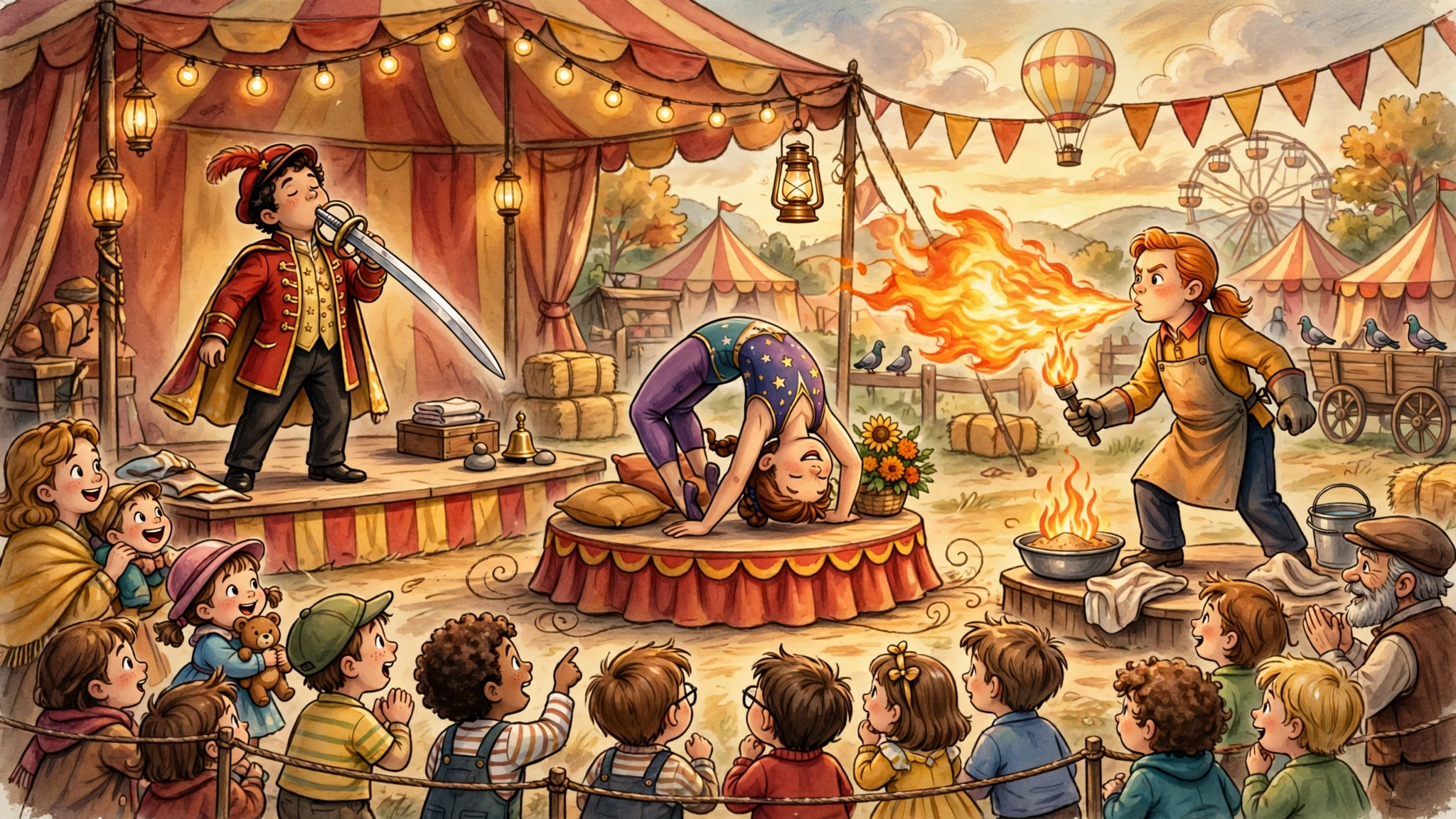
The Circus Is Here! 🎪
Have you ever been to a circus? There are clowns! 🤡 And jugglers! And people who do AMAZING tricks!
🎪
WOW! Look at That!
A long time ago, circuses had special tents where you could see AMAZING things. Strong people who could lift HUGE weights! 💪
People who could eat FIRE! 🔥 Yes, really! They put fire IN THEIR MOUTH!
🔥
That's Not Very Nice! 😟
But some things at old circuses were NOT nice. Some people were put on stage just because they looked different. That made those people sad.
We know now that EVERYONE is special no matter what they look like! 💕
💕
Circus Today!
Today's circuses are SO COOL! People fly through the air! 🤸 They do flips and spins! They dance and do gymnastics!
And NO ONE is made fun of. Everyone is a superstar! ⭐
🎭
Step Right Up! The Sideshow! 🎪
A sideshow was a special part of the circus. It was in a smaller tent next to the big tent. Inside, you could see people doing incredible things!
🔥 Amazing Performers
Fire-eaters could put burning torches in their mouths without getting hurt! Sword swallowers could slide a whole sword down their throat! Strongmen could bend metal bars with their bare hands!
These performers practiced for years and years to learn their acts. They were very skilled!
😟 Some Parts Were Sad
In the old days, some sideshows had "freak shows." People who were born looking different were put on display. Crowds would stare at them. This was mean and hurtful.
Imagine if people stared at you just because you looked different. It would feel terrible. We know now this was WRONG.
🎭 The New Circus!
Today we have amazing circuses like Cirque du Soleil! Instead of making fun of anyone, they celebrate what human bodies can DO. Acrobats, dancers, and artists create beautiful shows that make everyone smile!
Fun Facts!
- The word "sideshow" means it was on the SIDE of the main circus tent!
- P.T. Barnum started one of the most famous circuses ever in 1871!
- Fire-eaters use a trick: they blow OUT, not in, so the fire doesn't hurt them!
The Wild History of Sideshows 🎪
Before TV, movies, or the internet, one of the most exciting things you could see was a sideshow. These were small performances set up next to the main circus tent, offering a mix of genuinely amazing skills and, unfortunately, some acts that exploited people.
What Was a Sideshow?
A sideshow was literally a "show on the side." While the big top had acrobats and elephants, the sideshow tent featured unusual acts. A man called a barker would stand outside yelling to attract crowds: "Step right up! See the amazing fire-eater! See the world's strongest man!"
Common sideshow acts included:
- Fire-eating and fire-breathing — real skills that take years to master safely
- Sword swallowing — a genuine physical feat (not a trick sword!)
- Strongman acts — bending iron bars, lifting heavy objects
- Contortionists — people with extreme flexibility who could fold themselves into tiny boxes
- Escape artists — Harry Houdini started as a sideshow performer!
P.T. Barnum: Showman and Controversy
Phineas Taylor Barnum (1810-1891) was the most famous showman in American history. He opened Barnum's American Museum in New York City in 1841, then co-founded the famous Barnum & Bailey Circus in 1871. He was a genius at advertising and getting people's attention.
But Barnum also did terrible things. He displayed Joice Heth, an elderly enslaved woman, claiming she was 161 years old. He profited from people's curiosity about others who looked different. Many of the people in his shows had no real choice about being there.
Why "Freak Shows" Were Wrong
The saddest part of sideshow history is the "freak show." People born with physical differences — like being very tall, very short, or having unusual conditions — were put on stages for audiences to gawk at. They were given cruel stage names and treated as curiosities rather than human beings.
Some performers, like Chang and Eng Bunker (conjoined twins from Siam, now Thailand), became wealthy and famous. But many others were exploited, paid almost nothing, and had nowhere else to go. The system was built on inequality.
The Modern Circus: Cirque du Soleil and Beyond
Cirque du Soleil was founded in Quebec, Canada in 1984 by two street performers. It completely reinvented the circus by focusing on artistic performances — acrobatics, dance, music, and stunning visual design — with no animals and no exploitation.
Today's sideshow traditions survive in a new form: variety shows where performers CHOOSE to showcase skills like fire-eating, aerial silks, and contortion. The big difference? Everyone performs by choice, is paid fairly, and is celebrated for their talent.
Sideshows: Entertainment, Exploitation, and Evolution
The American sideshow represents one of the most complex chapters in entertainment history. It was simultaneously a space for genuine artistic expression and one of the most systematic forms of human exploitation in popular culture. Understanding it requires holding both realities at once.
Origins: Cabinets of Curiosity to Traveling Shows
Sideshow culture evolved from European "cabinets of curiosity" (Wunderkammern) of the 16th-17th centuries, where wealthy collectors displayed oddities from around the world. By the 1800s, traveling exhibitors brought similar spectacles to mass audiences. The dime museum and the circus sideshow became fixtures of American life from roughly 1840-1970.
The standard sideshow operated on a "ten-in-one" model: ten acts under one tent for a single admission price (usually 10-25 cents). A "talker" or "barker" outside the tent delivered a rapid-fire pitch to attract paying customers, while painted canvas banners depicted exaggerated versions of what was inside.
The Skill Acts
Many sideshow performers were genuine specialists:
- Sword swallowing — a real anatomical feat requiring suppression of the gag reflex and careful alignment of a 16-24 inch blade down the esophagus. The Sword Swallowers Association International (yes, it's real) documents about 50 active performers worldwide.
- Fire manipulation — fire-eaters use the principle of exhaled air creating a boundary layer between flame and skin. Fuel choices (lamp oil, not gasoline) and technique make it survivable but never completely safe.
- Escape artistry — Harry Houdini (1874-1926) began as a sideshow escape artist before becoming the most famous magician in history. His innovations in lockpicking, key concealment, and physical contortion were genuinely athletic achievements.
- Human blockhead — performers drive nails or spikes into their nasal cavity, exploiting the anatomical space behind the nose. Dangerous? Yes. A trick? No.
The "Freak Show": A Moral Reckoning
The term "freak" is now understood as a slur, but for over a century it was standard vocabulary. P.T. Barnum's career illustrates the moral complexity:
- He displayed Joice Heth, an enslaved elderly woman, as a 161-year-old curiosity (1835) — pure exploitation
- He promoted Charles Stratton ("General Tom Thumb"), who had dwarfism, as a performer — Stratton became wealthy and toured Europe, meeting Queen Victoria
- He exhibited the "Feejee Mermaid" — a taxidermy hoax combining a monkey and a fish
- He displayed William Henry Johnson ("Zip the Pinhead"), a Black man with microcephaly — one of the most disturbing examples of racial and disability exploitation in American entertainment
The disability rights movement of the 1960s-1970s, combined with changing public attitudes, effectively ended the freak show. The last major traveling freak show closed in the early 1970s.
The Reinvention: Cirque du Soleil and the "New Circus"
Guy Laliberté and Gilles Ste-Croix founded Cirque du Soleil in 1984 with a radical idea: a circus built on human artistry, not animal acts or exploitation. By 2019, the company employed 4,000+ people, had revenue exceeding $1 billion annually, and had been seen by 200+ million spectators worldwide.
The "new circus" movement also spawned companies like Circus Oz (Australia), NoFit State Circus (Wales), and the contemporary sideshow revival, where performers like The Lizardman (full-body tattoo and body modification) and Zamora the Torture King choose their public personas as artistic expression.
The Sideshow as American Mirror: Spectacle, Othering, and Reinvention
The American sideshow is not merely an entertainment curiosity. It is a lens through which we can examine some of the most persistent dynamics in American culture: the commodification of difference, the tension between agency and exploitation, and the evolving boundaries of acceptable spectatorship. What we choose to display — and what we choose to stare at — reveals as much about the audience as the performer.
The Political Economy of the Sideshow
The sideshow operated within a specific economic structure. The "ten-in-one" model (ten acts, one admission) was designed to maximize revenue per square foot of canvas. A typical traveling circus of the 1890s-1920s might have 3-5 sideshows operating simultaneously, each targeting different audience demographics. The blow-off (an additional act requiring a second payment inside the tent) extracted maximum revenue from the most curious patrons.
The labor economics were revealing. "Self-made freaks" (tattooed performers, fire-eaters, sword swallowers) typically earned more than "born freaks" (people with congenital conditions) because they possessed transferable skills and had more bargaining power. This distinction maps onto broader labor market dynamics: specialized skills command premiums over inherent characteristics.
Disability, Race, and the Gaze
The freak show operated at the intersection of disability and race in ways that scholars like Rosemarie Garland-Thomson (Extraordinary Bodies, 1997) and Robert Bogdan (Freak Show, 1988) have extensively analyzed. Bogdan identified two primary presentation modes:
- The "exotic" mode — performers were framed as specimens from distant, "savage" lands, reinforcing racial hierarchies. Ota Benga, a Mbuti man, was displayed in the Bronx Zoo's primate house in 1906.
- The "aggrandized" mode — performers were elevated to celebrity status, dressed in fine clothing, given noble titles. "General Tom Thumb" met Abraham Lincoln and Queen Victoria.
Both modes served the same function: defining normalcy by displaying its supposed opposite. As Michel Foucault argued in Abnormal (1999), the categorization of bodies as "normal" or "abnormal" is a form of social control.
The Agency Debate
One of the most contested questions in sideshow scholarship is whether performers had meaningful agency. The answer resists simplification:
- Chang and Eng Bunker (1811-1874), the original "Siamese twins," accumulated significant wealth, owned a plantation in North Carolina (and enslaved people — complicating any simple victim narrative), and controlled their own touring schedule.
- Schlitzie (Simon Metz, c. 1901-1971), who had microcephaly, was passed between managers throughout his life and likely lacked the cognitive capacity to consent meaningfully to his exhibition. His story raises fundamental questions about guardianship and exploitation.
- Many performers in the 1920s-1950s explicitly defended their careers, arguing that the sideshow gave them economic independence impossible in a society that otherwise excluded them from employment entirely.
The tension between economic necessity and genuine choice is not unique to sideshows — it pervades all labor under conditions of inequality.
From Exploitation to Expression
The contemporary sideshow revival (1990s-present) reframes the tradition as voluntary artistic expression. Coney Island USA, founded by Dick Zigun in 1980, operates an annual Sideshow by the Seashore and the Mermaid Parade, self-consciously preserving sideshow arts while rejecting exploitation. Jim Rose's Circus Sideshow (1992-2010s) brought sideshow acts to rock festival audiences.
Cirque du Soleil's revolution went further: it eliminated the concept of the sideshow entirely by making the entire production an artistic spectacle with no hierarchical distinction between "normal" and "other." The $1B+ company demonstrated that ethical entertainment could be more profitable than exploitative entertainment — a market signal that has reshaped the entire industry.
The Sideshow: Spectacle, Sovereignty, and the Construction of Normalcy
The American circus sideshow, flourishing from approximately 1840 to 1970, constitutes one of the most richly documented case studies in the cultural politics of embodiment, spectatorship, and the commodification of human difference. Far from a historical oddity, the sideshow's logics persist in reality television, social media virality, medical documentary programming, and the gig economy's relentless marketization of personal attributes. A serious reckoning with sideshow history requires engagement with disability studies, critical race theory, labor economics, and performance studies simultaneously.
Historiography: From "Curious" to Critical
Academic treatment of sideshows has undergone a paradigm shift. Early works (e.g., Drimmer's Very Special People, 1973) adopted an uncritical "amazing but true" posture. Robert Bogdan's Freak Show: Presenting Human Oddities for Amusement and Profit (1988) was foundational, introducing the "exotic" vs. "aggrandized" presentation framework and establishing that "freak" is a social construction, not an ontological category.
Rosemarie Garland-Thomson's Extraordinary Bodies: Figuring Physical Disability in American Culture and Literature (1997) extended the analysis by locating the freak show within the broader history of disability representation. Her concept of "normate" — the constructed subject position against which all bodies are measured — remains central to disability studies. More recently, Rachel Adams's Sideshow U.S.A. (2001) traced freak show aesthetics into post-1970 American culture, arguing that the impulse to spectacularize difference didn't disappear — it migrated to new media.
P.T. Barnum and the Industrialization of Spectacle
Barnum (1810-1891) is best understood not as an entertainer but as an industrialist of attention. His innovations anticipated modern media economics by over a century:
- Manufactured controversy — Barnum deliberately planted conflicting newspaper stories about his exhibits (was the Feejee Mermaid real or fake?), understanding that controversy itself generated attendance regardless of resolution. This is structurally identical to modern "engagement bait."
- Cross-platform monetization — Barnum simultaneously operated a museum, published pamphlets, arranged international tours, and licensed merchandise. Tom Thumb figurines, prints, and songbooks generated revenue streams independent of live performance.
- The "humbug" economics — Barnum's own term. He understood that audiences paid not just for authenticity but for the experience of adjudicating authenticity. Visitors to the Feejee Mermaid exhibit were purchasing the pleasure of scrutiny itself. This dynamic maps directly onto contemporary "is it real?" engagement with AI-generated content, deepfakes, and viral hoaxes.
His exploitation of Joice Heth (1835) — an enslaved elderly woman displayed as George Washington's 161-year-old nurse — sits at the intersection of chattel slavery, disability exhibition, and media fraud. After her death, Barnum charged admission to her public autopsy. The episode crystallizes everything that was wrong with the sideshow's worst impulses: the commodification of Black bodies, the obliteration of consent, and the treatment of death itself as spectacle.
Labor Relations and Performer Agency
The question of agency within sideshow labor has generated significant scholarly debate, most productively in Nadja Durbach's Spectacle of Deformity: Freak Shows and Modern British Culture (2010). Key considerations include:
- Structural constraint vs. informed consent: In a society that offered no employment, housing discrimination protections, or social services for people with visible disabilities, the sideshow was often the best available option. "Choice" under such conditions is real but radically constrained — a dynamic familiar from gig economy labor scholarship.
- The "self-made freak" premium: Performers who acquired their novelty (full-body tattoos, practiced skills like sword swallowing) consistently commanded higher wages and better contractual terms than those whose exhibit value derived from congenital conditions. This tracks with human capital theory but also reveals the darker implication: bodies-as-capital appreciate through modification and depreciate through familiarity.
- Community formation: Sideshow performers frequently formed tight-knit communities, intermarrying, sharing accommodations, and collectively bargaining with show management. The "sideshow family" trope, while sometimes romanticized, reflects genuine mutual aid networks that developed under conditions of social exclusion.
Legislative and Cultural Extinction
The freak show's decline was overdetermined:
- "Ugly laws" — municipal ordinances (e.g., Chicago's 1881 ordinance prohibiting "diseased, maimed, mutilated, or in any way deformed" persons from appearing in public places) paradoxically both reflected and reinforced the freak show's logic by criminalizing visible disability. The last such law (Chicago's) wasn't repealed until 1974.
- Medical model ascendancy — as medical science identified genetic, endocrine, and developmental conditions underlying "anomalous" bodies, the freak show's mystification lost its epistemological ground. The "bearded lady" became "a woman with hirsutism" — legible through pathology rather than spectacle.
- Disability rights activism — the independent living movement (Ed Roberts, Berkeley, 1960s-70s) and ultimately the Americans with Disabilities Act (1990) reframed disability from individual tragedy to social construction, rendering freak show exhibition both culturally unacceptable and legally precarious.
- Television — the sideshow's function as purveyor of the unusual was absorbed by television. Ripley's Believe It or Not!, That's Incredible!, and eventually TLC's programming slate (from Little People, Big World to My 600-lb Life) continued freak show dynamics through a medical-documentary frame that Adams (2001) terms "the medical freak show."
The Contemporary Sideshow Revival
Since the 1990s, a self-conscious sideshow revival has operated under explicitly different ethical premises. Coney Island USA's annual Sideshow by the Seashore, Jim Rose's Circus Sideshow, the Venice Beach Freakshow (2006-2017), and performers like Mat Fraser (actor with phocomelia who deliberately engages freak show history in his work) reclaim sideshow traditions as voluntary artistic practice.
Cirque du Soleil's founding (1984) and subsequent commercial dominance ($1B+ annual revenue pre-COVID, 200M+ cumulative spectators) demonstrated that the market for spectacular embodied performance was vastly larger than the sideshow's defenders imagined — it simply needed to be decoupled from exploitation. The company's pandemic-era bankruptcy (2020) and subsequent restructuring under Catalyst Capital's ownership introduces new questions about whether ethical entertainment models survive financial distress.
Persistent Logics
The sideshow's fundamental operation — the monetized display of bodies that deviate from constructed norms — has not disappeared. It has been redistributed across platforms:
- Reality television — programs featuring people with unusual bodies, extreme behaviors, or marginalized conditions reproduce sideshow spectatorship under the alibi of "documentary" interest
- Social media virality — the algorithmic amplification of unusual bodies and behaviors for engagement metrics is structurally identical to the sideshow barker's pitch, with the platform extracting the admission fee (attention/data) rather than the performer
- Medical crowdfunding — GoFundMe campaigns for people with visible disabilities or unusual conditions often require the spectacularization of suffering as a prerequisite for financial support, recreating freak show economics through philanthropic framings
As Garland-Thomson's framework suggests, the sideshow was never really about the performers. It was about the audience's need to construct and patrol the boundaries of normalcy. That need persists; only its venues have changed.